
What it is
Compound Engineering is a plugin of 36 AI skills built on the philosophy that each unit of engineering work should make subsequent units easier, not harder. The core loop has six steps: ce-brainstorm (interactive Q&A to think through features before planning), ce-plan (convert ideas into implementation-ready plans), ce-work (execute plans with native or cross-model authors), ce-simplify-code (refine code for clarity before review), ce-code-review (multi-agent review against the plan), and ce-compound (capture learnings into docs/solutions/ for future use). The key differentiator is the compounding mechanism. Each cycle reads prior knowledge stored in artifact folders (docs/solutions/ for learnings, docs/plans/ for implementation plans), making subsequent cycles progressively more informed. The maintainers describe it as "run one teaches it, run two remembers." This creates an institutional memory within the project that grows with each engineering iteration. Beyond the core loop, supporting skills cover autonomy (/lfg runs the entire pipeline hands-off), on-demand tasks (ideation, debugging, optimization, prototyping, document review), git workflow (committing, PR management, CI shepherding), testing and design (browser testing, polish, dogfooding), and collaboration (proof-of-concept, handoff, promotion utilities). The plugin supports 14 platforms including Claude Code, Cursor, Codex, Kimi Code, Cline, Grok Build, and others.
Who it's for
- software engineers
- engineering teams
- technical leads
- solo developers
Requirements
Requirements
- Claude Code, Cursor, Codex, or 11 other supported agent platforms
Setup
Step 1
bash/plugin marketplace add EveryInc/compound-engineering-pluginStep 2
bash/plugin install compound-engineering
مجموعة من 36 مهارة ذكاء اصطناعي تنظم العمل الهندسي حول حلقة عصف ذهني-تخطيط-بناء-تبسيط-مراجعة-تراكم.
Examples
Core workflow
Prompt/ce-brainstorm make background job retries saferExpected output: Starts the compound engineering loop: interactive Q&A to think through the feature, then /ce-plan, /ce-work, /ce-simplify-code, /ce-code-review, and /ce-compound to capture learnings.
Autonomous mode
Prompt/lfgExpected output: Runs the entire brainstorm-to-ship pipeline hands-off after an initial brainstorm.
Pros & cons
Pros
- Pro:Core philosophy: each unit of work makes subsequent units easier
- Pro:36 skills covering brainstorming, planning, building, reviewing, git workflow, and testing
- Pro:Autonomous /lfg mode for hands-off pipeline execution
- Pro:Knowledge capture in docs/solutions/ so run two remembers what run one learned
Cons
- Con:Learning accumulation requires consistent use within the same project over time
Related
 Skill
Skill explanatory-output-style
Adds educational insights about implementation choices and codebase patterns (mimics the deprecated Explanatory output style)
 Skill
Skill learning-output-style
Interactive learning mode that requests meaningful code contributions at decision points (mimics the unshipped Learning output style)
 Skill
Skill Understand-Anything
Graphs that teach > graphs that impress. Turn any code into an interactive knowledge graph you can explore, search, and ask questions about. Works with Claude Code, Codex, Cursor, Copilot, Gemin...
 Skill
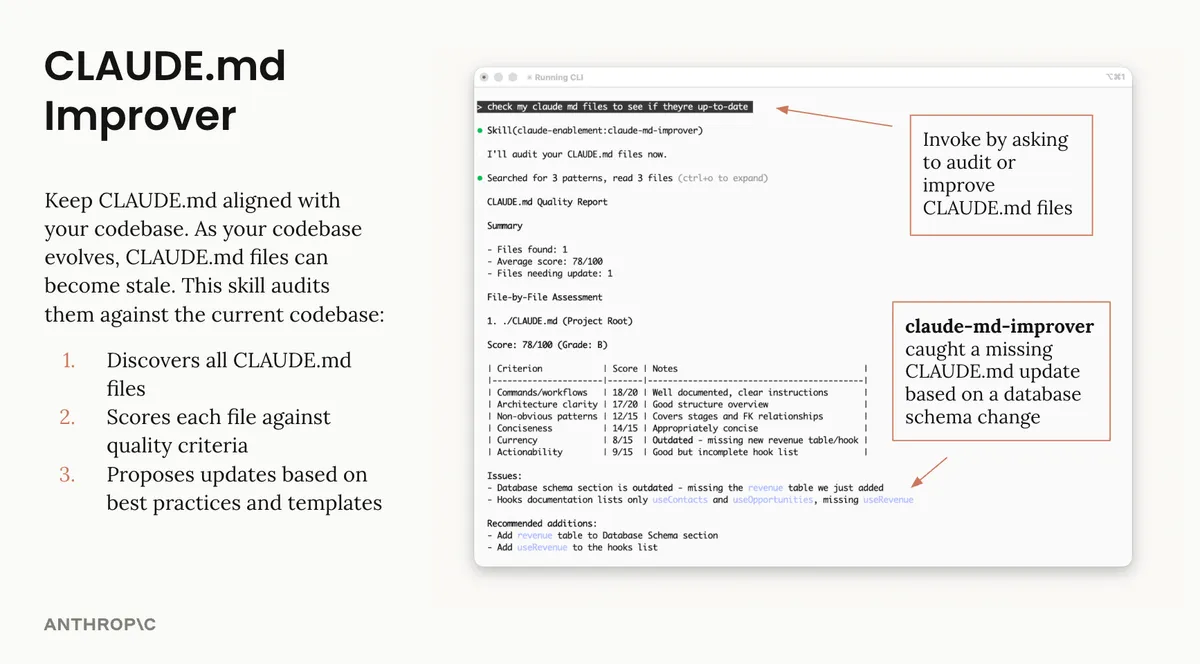
Skill claude-md-management
Tools to maintain and improve CLAUDE.md files - audit quality, capture session learnings, and keep project memory current.
 Skill
Skill explanatory-output-style
Adds educational insights about implementation choices and codebase patterns (mimics the deprecated Explanatory output style)
 Skill
Skill learning-output-style
Interactive learning mode that requests meaningful code contributions at decision points (mimics the unshipped Learning output style)