
 Tool
ChatGPT
General-purpose AI assistant for writing, research and coding.
223 hand-picked AI tools, including 6 top picks. Filter by category or pricing, then open any tool for a source-based overview. Pricing changes often, so always check the official site.
 Tool
General-purpose AI assistant for writing, research and coding.
 Tool
AI assistant known for long documents, careful writing and coding.
 Tool
Google's AI assistant connected to its ecosystem.
 Tool
AI assistant from xAI with real-time context from X.
 Tool
AI answer engine that cites its sources.
 Tool
High-quality AI image generation.
 Tool
Ask questions about your own documents and generate audio overviews.
 Tool
AI video generation and editing tools.
 Tool
Realistic AI voices, dubbing and text-to-speech.
 Tool
Generate songs from a text prompt.
 Tool
Design platform with built-in AI features.
 Tool
AI-powered code editor.
 Tool
AI pair programmer inside your editor.
 Tool
Connect apps and automate workflows, with AI steps.
 Tool
Open-source workflow automation with AI agent nodes.
 Tool
Bardeen sources leads with an agentic web scraper, qualifies them with AI and enriches contacts.
 Tool
The AI presentation platform built for enterprise teams. Beautiful.ai keeps every deck on-brand and ready to share across the whole company.
 Tool
Build and scale high-performing websites & apps using your words. Join millions and start building today.
 Tool
Browse AI scrapes web data, monitors webpage changes and turns websites into APIs.
 Tool
Captions is an AI video generator and editor that makes it easy to go from idea to ready-to-share content. Get great videos every time, no matter your skillset.
 Tool
Infrastructure to get any data, run agentic workflows, and launch GTM plays.
 Tool
ClickUp Brain is ClickUp's AI that connects projects, docs, people and company knowledge.
 Tool
Colossyan Creator makes video creation simple and stress-free. Discover our AI video generator with real actors. Create AI videos in less than 5 minutes.
 Tool
Introducing the first-ever GTM AI platform. Automate hundreds of tedious, repetitive tasks and empower your team to scale success like never before.
 Tool
DeepL translates text, speech and media and offers the DeepL API.
 Tool
Descript is the AI video and audio editor that makes editing as easy as editing text. Record, transcribe, edit, and publish in one tool. Try it free.
 Tool
Elicit helps you synthesize evidence, understand the landscape, design programs and experiments, draft proposals, and weigh tradeoffs. Trusted by over 7 million researchers and 8 of the top 20 pharmaceutical companies
 Tool
Fathom captures, transcribes and summarizes Zoom, Google Meet and Teams calls, free for individuals, with CRM updates for teams.
 Tool
Fireflies takes notes, manages tasks, and automates workflows across meetings, email, chat, CRM, and your apps. Build a searchable knowledge base of your team\u2019s work in one place.
 Tool
Go from idea to launch with an agent that designs and builds on the canvas. Keep each change editable, with hosting, security, analytics, CMS, and SEO built in.
 Tool
Freepik is a platform for stock images, vectors and AI image generation, with a free plan and paid plans.
 Tool
Gamma is your free-to-use AI design partner for creating effortless presentations, websites, and more. No coding or design skills required.
 Tool
Grammarly makes AI writing convenient. Work smarter with personalized AI guidance and text generation on any app or website.
 Tool
The AI notepad for back-to-back meetings. Notes, actions and memory. Without a meeting bot.
 Tool
Generate AI videos from your ideas using HeyGen. Input text, image, or audio to create complete videos with narration, captions, visuals, and animations.
 Tool
Humata turns your documents into a knowledge base for instant analysis and answers.
 Tool
Create & edit AI videos with Agent Two
 Tool
Orchestrate intelligent agents to run end-to-end marketing workflows delivering speed, control, and measurable impact.
 Tool
Kapwing generates and edits full video projects from a prompt for creators.
 Tool
Krea is the world's most powerful creative AI suite. Generate, edit, and enhance images and videos using powerful AI for free.
 Tool
Krisp cancels background noise, records, transcribes, and summarizes meetings and calls.
 Tool
Lindy is an AI employee that connects to your tools and does real work for the team.
 Tool
Lovable is an AI software engineer, which enables anyone to build for the web. Simply chat to instantly build websites and web apps, with no technical knowledge needed.
 Tool
Luma AI is the creative AI platform for video generation and image creation. Powered by the world's leading video generation models, Ray and Uni, and creative agents handling end-to-end workflows. Trusted by leading agencies and brands. Try it free.
 Tool
Magnific offers AI creative tools with stock content; higher tiers include unlimited generations.
 Tool
Manus is the action engine that goes beyond answers to execute tasks, automate workflows, and extend your human reach.
 Tool
Mem Agent is an AI chief of staff that tracks your tasks, projects and goals from your notes and steps in at the right moments.
 Tool
Motion is the #1 Rated Productivity Platform for the AI Era. AI Projects, AI Tasks, AI Calendar, AI Meetings, AI Docs, AI Notes, AI Reports, AI Workflows, and more.
 Tool
Napkin AI turns text into visuals such as diagrams and graphics; the free plan adds Napkin branding.
 Tool
Notta transcribes, summarizes and generates action plans from meetings, interviews and recordings.
 Tool
OpusClip turns long videos into high-quality viral clips, and publishes them to all social platforms in one click. We help 20M+ creators create and grow faster.
 Tool
Otter AI Meeting Agent supports real-time transcription, live chat, automated summaries, insights, and action items.
 Tool
Photoroom creates product and portrait pictures from your phone: remove and change backgrounds and showcase products.
 Tool
Create Professional Videos - Faster, Easier, and Cheaper With Our Flexible Plans
 Tool
AI creative tools. Built for Creatives.
 Tool
A collection of powerful productivity tools all within an extendable launcher.
 Tool
Read AI is an AI meeting notetaker for Teams, Meet, Zoom and more, with apps on desktop and mobile.
 Tool
Describe what you want. Replit builds it. Get a working app or website in minutes. No coding required.
 Tool
Rytr is an AI relationship manager that pulls client context from Gmail, Slack, calendars and meeting notes, prepares meetings and drafts follow-ups in your voice.
 Tool
Scite searches 300M+ scholarly articles and shows whether claims are supported or disputed by citations.
 Tool
Shortwave is an agentic AI email client that organizes, writes, searches and schedules from a prompt.
 Tool
Speechify reads books, PDFs and web pages aloud with natural voices.
 Tool
Steve AI - The only AI video maker with 3 patents, Trusted by 7M+ users. Turn blogs, ideas, or audio into professional AI videos.
 Tool
Sudowrite is an AI writing partner for fiction that helps novelists write faster.
 Tool
Surfer tracks and improves brand visibility across Google and AI search engines such as ChatGPT, Gemini and Perplexity.
 Tool
Official Synthesia site. The AI video platform trusted by 90%+ of the Fortune 100 to communicate, train, and upskill teams in 140+ languages.
 Tool
Tactiq captures meeting transcripts in real time and produces notes, action items and summaries.
 Tool
Taskade Genesis turns business processes into live apps such as CRMs, dashboards and portals with AI agents and automations.
 Tool
Tavily is a real-time search engine for AI agents with APIs for web search and content extraction.
 Tool
Topaz Labs makes deep-learning photo and video enhancement software for noise reduction, sharpening and upscaling.
 Tool
Your collaborative AI assistant to design, iterate, and scale full-stack applications for the web.
 Tool
Build your software factory on Warp: factories as code, any model or harness, with evals, benchmarks, and self-improvement built in.
 Tool
Manage fleets of local and cloud agents from one surface. Plan, delegate, review, and ship without leaving your editor.
 Tool
Wordtune is an AI writing assistant that rewrites, paraphrases and refines text for clarity and tone.
 Tool
The AI Search Growth Engine. GEO, AEO, and AI visibility in one platform. Track 8 AI platforms, run the work, prove the lift. Trusted by Amazon, Unilever, Acer & NP Digital.
 Tool
You.com offers AI-ready web search and contents APIs for building products.
 Tool
Aider is an open-source terminal-based AI pair programming tool that lets you collaborate with LLMs to edit code in your existing Git repository, with automatic commits for every change.
Tool Augment Code is an AI development platform aimed at teams working in large, production-scale codebases, with tools such as Cosmos, a CLI and AI code review. Pricing page on 2026-10-30: Standard $20/month, Business $100/month, Enterprise custom; no free tier is listed, though trials are mentioned.
Tool Base44 builds working apps from a plain-language description, including the frontend, backend, database and user sign-in, so non-developers can ship internal tools and small products. Pricing page on 2026-10-30 (paid plans billed annually): Free $0, Starter $16/mo, Builder $40/mo, Pro $80/mo, Elite $160/mo.
Tool Cartesia makes real-time voice AI: Sonic for text to speech, Ink for speech to text, and Managed Agents for building voice agents. Pricing page on 2026-10-30: Free $0/mo with 20K credits a month, Pro $5/mo, Startup $49/mo, Scale $299/mo, Enterprise custom.
Tool Cline is an open-source autonomous AI coding agent with Plan/Act modes, terminal execution, multi-file editing, and Model Context Protocol support, available as a VS Code extension, desktop app, and CLI.
Tool Consensus is an AI research search engine that finds peer-reviewed papers, summarises what they found and labels their study designs, so you can see what the evidence says on a question. The pricing page lists Individual and Team and Enterprise plans with monthly or annual billing.
Tool Continue was an open-source AI code assistant for VS Code and JetBrains that has been acquired by Cursor; the open-source codebase remains freely available.
Tool GitHub Copilot Workspace is a Copilot-native developer environment that takes you from a natural language idea or GitHub Issue to a verified pull request, with AI agents handling the plan-to-code pipeline.
Tool DALL-E was OpenAI's text-to-image generation model integrated into ChatGPT; DALL-E 3 was retired on May 12, 2026, and replaced by GPT-4o's native image generation capabilities.
Tool Devin is an autonomous AI software engineer by Cognition that plans, codes, tests, and opens pull requests in a sandboxed cloud environment, with integrations for Slack, GitHub, Linear, and Jira.
Tool Factory sells AI software-development agents that run in a desktop app, a CLI and an SDK, as cloud or local background agents. Pricing page on 2026-10-30: Pro $20/mo, Plus $100/mo, Max $200/mo, Teams $60/mo per team plus $40/mo per seat; Business and Enterprise on request. No free tier listed. The site moved from factory.ai to factory.com.
Tool Fliki turns ideas, scripts, blog posts or PowerPoint files into narrated videos. Plans on the pricing page: Free (free forever), Standard and Premium (per user per month), and Enterprise (custom pricing).
Tool FLUX is a family of text-to-image models by Black Forest Labs using a Flow Matching architecture, offering open-weight variants that run on consumer hardware and a closed API for the highest quality tier.
Tool Groq is an AI inference cloud built on its proprietary LPU (Language Processing Unit) processor and LPX technology, providing fast and affordable inference at scale for millions of developers running trillions of tokens weekly.
Tool Hedra offers AI video, image, audio and language-model generation through its Studio app and an API, billed from a prepaid balance rather than fixed plans. Pricing page on 2026-10-30 lists pay-as-you-go rates such as video generation from 1.22 cents per second and LLM input from $0.15 per 1M tokens, with voice cloning marked free.
Tool Higgsfield is an AI video platform for creating videos, animations and ads; its pricing page promises unlimited access to its AI video tools on paid plans. Plan prices are on the pricing page (not readable by our fetcher on 2026-10-30, so none are quoted here).
Tool Hugging Face is the AI community platform hosting 2M+ machine learning models, 500K+ datasets, and 1M+ AI applications, with open-source libraries and inference infrastructure used by 400,000+ organizations.
Tool Ideogram is an AI image generation platform known for rendering text within images with 90 to 95 percent accuracy, making it the go-to tool for posters, logos, infographics, and any image that contains words.
Tool Kilo Code is an open-source AI coding assistant for VS Code, JetBrains and the command line that works with many AI models. Pricing page on 2026-10-30: Free & Open Source for individuals, Teams $15/user/month, Enterprise custom; model usage is billed separately, with an optional Kilo Pass at $19/mo.
Tool Kling AI is a generative platform for creating high-quality videos and images from text, images, and references, with features including native 4K image generation, motion control, and an all-in-one Canvas workspace.
Tool Notion AI is an integrated AI workspace that helps teams capture knowledge, find instant answers with citations across connected apps, and deploy agents to automate repetitive tasks around the clock.
Tool OpenRouter gives developers API access to 600+ models from 80+ providers through one account, billed at each provider's list price. Pricing page on 2026-10-30: Free (no platform fee), Standard pay-as-you-go with a 5.5% fee, Business pay-as-you-go with an 8% fee, Enterprise with fee discounts.
 Tool
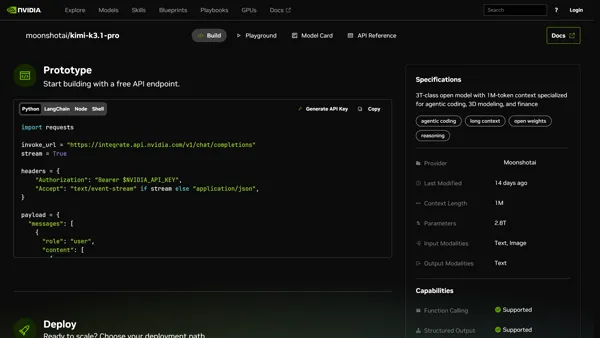
Moonshot AI's Kimi K3.1 Pro coding model, hosted by NVIDIA on build.nvidia.com with a free trial API endpoint. OpenAI-style API, 1M-token context, 2.8T parameters. Trial for building and testing, not production.
Tool Recraft is an AI image tool built for designers: it generates and edits images and vector graphics, with background removal, inpainting and outpainting, plus a developer API. Plans on the pricing page: Free, Basic, Pro and Teams.
Tool Replicate is a cloud API platform for running, fine-tuning, and deploying thousands of open-source ML models with one line of code, paying only for compute used, with auto-scaling infrastructure.
Tool Riverside records studio-quality audio and video remotely, with tools for editing, AI-assisted clip creation, live streaming and podcast hosting. It has a free plan and paid tiers (Pro, Grow, Webinar, Business); check the pricing page for current prices.
Tool Stable Diffusion is an open-source image generation model by Stability AI that can run locally on consumer hardware, with a cloud API also available for production use.
Tool Together AI is an AI cloud platform offering serverless inference, batch processing, fine-tuning, and GPU clusters for open-source models across text, image, video, code, and voice, used by Cursor, ElevenLabs, and Salesforce.
Tool VEED is an online video suite for capturing, editing and broadcasting videos with cloud-based tools. It can be started for free, with paid plans for more features; current prices are on the pricing page.
Tool Wispr Flow is a voice dictation app that types what you say into any app on Mac, Windows, iPhone and Android, in 100+ languages, and adds a Notetaker for meeting notes and voice memos. Pricing page on 2026-10-30: Free $0/mo; Pro $15/user/mo monthly or $12/user/mo annual; Growth $23/user/mo monthly or $18/user/mo annual; Enterprise custom.
Tool Zed is a fast, open-source code editor with real-time multiplayer collaboration and optional AI features that you can switch off. Pricing page on 2026-10-30: Personal $0 forever, Pro $10 per month with a free trial, Business $30 per seat per month.
Tool The README is written as instructions an agent can follow to install it and use it as a local search service. Install via cargo or Docker.
Tool Searches documents, images and code. The README says nothing leaves your machine. Speed figures are the author claim.
Tool Per the README, Hob picks the best frontier open-weight model that fits your computer and sets everything up. It is free, private and works offline, for Mac, Windows and Linux (hob.chat).
Tool The README says results stay local. You can build each step yourself or describe a task and have an agent create the workflow.
Tool From Arthur AI. It runs in your own environment and forwards findings to Elasticsearch, Splunk or any webhook.
Tool Open-source, local-first. The README puts it as agents that use your team tools while keeping a human yes in front of real-world actions. Site: tucano.sh.
Tool The README describes one timeline per thing, with decisions such as findings, plans and reviews kept there. It also exposes an MCP endpoint.
Tool Captures, diffs and reports visual regressions fully locally, with a Playwright SDK.
Tool Agent Guild runs on your computer and serves one local web page. It is free and runs on Windows, macOS and Linux.
Tool A Rust CLI from Vercel Labs that gives an agent a browser it drives one shell command at a time. snapshot returns the page with a ref such as @e1 for each element, and the agent acts on a ref. A click fails rather than reporting success when the target is hidden or covered. Apache-2.0. GitHub trending on 2026-11-04: 45,498 stars, +133 that day.
Tool Floci is an MIT-licensed local AWS emulator. Point AWS SDKs, the CLI and IaC tools at http://localhost:4566 with no cloud account or auth token. The README cites 2,576 automated compatibility tests across five SDKs and three IaC tools and emulates Bedrock AgentCore as a control plane with canned invocation responses. GitHub trending on 2026-11-04: 29,002 stars, +482 that day.
Tool A self-hosted system for persistent bots, available on the web, as an Electron app and on iPhone and Android. Bots keep memory and routines. You bring your own model, and it can run on Docker, E2B, Daytona and other providers. The project is in beta. Apache-2.0. GitHub trending on 2026-11-04: 6,973 stars, +151 that day.
Tool Beacon is a memory layer across Claude Code, Cursor, Codex, OpenCode and, by its count, 20+ harnesses. Sessions can be replayed, and what it learns is shared with agents through MCP or skills. It is local-first with JSONL storage, but interactive setup preselects the hosted Beacon Cloud with a Local opt-out, so read that screen. MIT. GitHub trending on 2026-11-04: 3,269 stars, +75 that day.
Tool A desktop ChatGPT alternative that runs offline on your own machine. It also exposes a local server at localhost:1337, so other apps can talk to your local model, and it supports MCP. Install it from jan.ai as a normal desktop download. Apache-2.0. 45,465 stars on GitHub on 2026-11-05, up 62 that day.
Tool A pipeline engine with a C++ core: AI pipelines live in .pipe JSON files and you build them visually in a VS Code extension, then run them on the engine from Python or Docker. Because the pipeline is a plain file, it can sit in your repo and go through review like code. MIT. 19.9k stars on GitHub on 2026-11-05.
Tool Runs persistent teams of Claude Code, Codex and Pi agents in tmux, defined by YAML specs and controlled through a CLI, a TUI or MCP. The README gives a dry run and a plan step before anything starts, which is useful when you are launching several agents in a repo. Needs Node 22 or 24 and tmux; Windows works only through WSL2. Apache-2.0. 8.6k stars on GitHub on 2026-11-05.
Tool A native macOS agent harness written in Swift that can run offline, with memory, a sandbox VM, and MCP as both server and client. It is Mac only: macOS 15.5 or newer on Apple Silicon, so skip it on Windows or Intel Macs. MIT. 8.1k stars on GitHub on 2026-11-05.
Tool Local search over the session history of your coding agents, so you can find how a past problem was solved instead of asking the agent to rediscover it. It also has ctx blame, ctx graph and ctx sift commands. Caveat from the project: transcript text is not automatically redacted, so secrets pasted into a session stay searchable. The external semantic executor and the Jev selector send data out only if you enable them. Apache-2.0. About 1.2k stars on GitHub on 2026-11-05.
Tool A local emulator of SaaS APIs (Slack, Gmail, Drive, GitHub, Jira, Notion, S3) for testing agents. An agent that posts a message or deletes a file does it against the fake service, so a bad run costs nothing and touches no real account. Apache-2.0. 230 stars on GitHub on 2026-11-05.
Tool Described by its authors as "An open-source CLI for hillclimbing Agent Experience." It runs real agent sessions in Docker against your skill, CLI, MCP server or docs, so you see whether an agent can actually use them. Telemetry is on by default and sends command name, timestamp, CLI version and an install ID; turn it off with gauge telemetry disable. MIT. 57 stars on GitHub on 2026-11-05; 24 points on Hacker News.
Tool An AI video editor and media manager from a YC S23 company. An agent reads your footage and makes the cut, and every clip stays on the timeline for you to adjust. It also stores and transcribes footage and handles review through shared links, with camera originals such as RED, Blackmagic RAW and ProRes playing without transcoding. The editor core is built on Remotion. The Hacker News launch post says the free tier includes MCP access for your own agent and that Pro adds unlimited MCP tool calls. Desktop only for now (Electron, on macOS, Windows and Ubuntu). The pages read do not say whether it is open source.
Tool Microsoft's open-source voice AI project. The ASR side transcribes up to 60 minutes of audio in one pass with speaker labels and custom hotwords (VibeVoice-ASR-7B, plus streaming and a CPU-oriented BitNet variant). The speech side has a long-form multi-speaker model (TTS-1.5B) and a real-time 0.5B model. Per the README the TTS code was removed on 2025-09-05 after reports of misuse, and the project is intended for research and development only, with no recommendation for commercial use without further testing. Synthetic speech can enable impersonation, so disclose AI use. The page gives no install steps; it links per-model docs, Hugging Face and a Colab notebook. MIT. About 55.5k stars on GitHub on 2026-11-05.
Tool End-to-end testing framework for web and mobile apps where you describe a goal in natural language and an agent drives the app. Agent steps that a later assertion confirms are recorded and replayed without model calls until the app changes. Web runs on Playwright (Chromium, Firefox, WebKit); mobile runs on iOS and Android simulators. Agent steps need a model: your own key, subscription or local model, or Claude Code or Codex. The project is heading to 1.0 and says APIs and config can still change between minor releases. Anonymous usage data is on by default; opt out with npx e2e telemetry disable. Apache-2.0. About 13.3k stars on GitHub on 2026-11-05.
Tool Terminal agent runtime in Rust, shipped as one binary of about 32 MB. A background daemon keeps sessions alive so several terminals can attach, named subagents run in parallel, and agents receive short-lived scoped tokens instead of your API keys. Works with Claude, Codex, Grok, Copilot, Gemini, Kimi, Azure OpenAI, Bedrock, Vertex, Ollama and OpenAI-compatible endpoints; extensions speak JSON-RPC and MCP servers are supported. Not a sandbox: tools run with your user permissions, so use a container or VM for untrusted work. Young project; Azure, Bedrock and Vertex are text-only for now. Apache-2.0. 53 stars on GitHub on 2026-11-05.
Tool Local security filter for coding agents including Claude Code, Codex CLI and Cursor. It scans the last 30 days of your sessions for known secrets, reports which commands came from text the agent read, and installs hooks that deny commands like curl | sh or outbound calls carrying a known secret. It prints key names, never values, and the README says it sends nothing and has no telemetry. The README is blunt that it is a filter, not a sandbox: matching is text-level and a command the model writes from scratch will not trace to a source. Needs Node.js 22 or later. Apache-2.0. 19 stars on GitHub on 2026-11-05.
Tool Static scanner that lists code in a repo or Python environment that can run on its own: VS Code and Cursor tasks, agent hooks for Claude Code, Cursor, Gemini CLI and Windsurf, MCP server configs, dev container commands, git hooks, npm install scripts and Python .pth files. It reads files and never runs them. The README says no findings means nothing obvious, not that a repo is safe, and obfuscated code can hide. Python 3.11 or later; has a GitHub Action, pre-commit hook and SARIF output. MIT. 1 star on GitHub on 2026-11-05, so very new.
Tool AI video editor you steer by describing the edit: trims and cuts, animated captions, text effects, background removal, masks, speed ramps and exports in 9:16, 1:1 and 16:9 at 1080p without a watermark. MCP support lets compatible agents edit too, and you can still adjust a manual timeline. Pricing on the site on 2026-11-05: one plan, Revline Pro, $39 per month after a 3-day trial; there is no free tier despite a free-to-start banner. The Show HN post calls it open source and the footer links github.com/revlinehq/Revline, but the site states no licence and the repo was not opened, so treat the open-source claim as unconfirmed.
Tool A desktop AI workstation for Windows, macOS and Linux. It connects many model providers, including local ones through Ollama and LM Studio, and adds agents, skills, MCP and knowledge bases in one app. The community edition is AGPL-3.0, with a separate commercial licence available. Enterprise pricing is on request. 53.3k stars on GitHub on 2026-11-06.
Tool Creates and edits draw.io diagrams from chat. It supports 25 model providers and can run as a web app or as an MCP server for Claude Code. Diagram quality depends on using a capable model, and the public demo has a usage limit. Licence Apache-2.0. 36.7k stars on GitHub on 2026-11-06.
Tool A self-hostable workflow automation platform, positioned as an alternative to Zapier. Its integrations, called pieces, can also be used as MCP servers for AI agents. The Community edition is MIT, and enterprise features are under a commercial licence, so check which parts you use. The project's pages give different integration counts (about 400, 280+ and 200+), so do not quote one as fact. 25.4k stars on GitHub on 2026-11-06.
Tool A self-hosted studio that makes videos through Claude Code and HyperFrames and publishes them to 9 platforms. It needs about 16 GB of RAM and 20 GB of disk. Read the permissions first: the launcher and cloud setup default to bypass mode, and the README says its safe mode is not a security boundary. Using a Claude subscription here is governed by Anthropic's terms. YouTube uploads stay private and TikTok posts stay Only me until the app passes those platforms' audits. Licence MIT. 131 stars on GitHub on 2026-11-06.
Tool An agentic librarian for macOS that keeps a local library of what you save and can research for you. It uses Apple Intelligence or your own API key, and web research needs a hosted model. It needs macOS 26 on Apple silicon. The site says it is free and MIT licensed; we did not open the repo to confirm that. It is early, with 4 points on Show HN.
Tool A voice-to-action agent for the Mac: hold the right Command key, say what you want, and it does the work. It needs macOS 15.4 or later on Apple silicon. The free plan is USD 0 and runs agent tasks through your existing AI account. Plus is USD 15 a month, billed monthly, and adds spoken replies and more accurate transcription. The site says it asks before irreversible or money actions and claims zero data retention; we could not verify either claim. Licence not stated, treat as proprietary.
Tool A kit that has Claude Code or Cursor make short films with three.js and ffmpeg, with a guard that stops some mistakes mid-run. The README is mainly Turkish, with an English version. Needs Node 22 or later, Python 3.9 or later, ffmpeg and Chrome with a working GPU, and film mode needs a few GB per film. The README says a full film on Windows has not been tried yet. Licence MIT. 442 stars on GitHub on 2026-11-06.
Tool Self-hosted remote control for Claude Code and Codex: chats, approvals, terminals, files, git and a browser on your computers, from a web app that also installs on phones. This is high-trust remote access, and it is not end-to-end encrypted: your server keeps the history, so read the security model first. Licence Apache-2.0; the name and logo are not licensed for modified versions. 101 stars and 0 forks on GitHub on 2026-11-06.
Tool Your agent writes a scenario and Screenplay films it in a browser or desktop app, then edits it with a smooth cursor, automatic zooms, callouts and captions. It contains no AI and needs no model key; voice-over is optional through Cartesia, ElevenLabs or your own audio files. Init adds an MCP server to Claude Code, Codex and Cursor configs and downloads Chromium. Licence MIT. 75 stars on GitHub on 2026-11-06.
Tool A read-only Windows x64 disk analyser that agents can call, packaged as a Claude Code plugin with the skill and a prebuilt binary. Answers questions such as why a disk is full and what grew this week. The binary is not code-signed yet, so SmartScreen may warn; the README explains how to verify the build. Described as a v1 candidate, with self-run benchmarks. Licence Apache-2.0. 71 stars on GitHub on 2026-11-06.
Tool AI image detection with a heatmap, plus frame-by-frame video checks, on the web, by browser extension and by API. Its 99.96% image accuracy comes from the company's own test set. Individual $20 a month with a 7-day trial, Professional $65 a month, Team from $40 a month for 2 seats, per the pricing page on 2026-11-06.
Tool 33 animated React charts in pure SVG with no runtime dependencies beyond React, and keyboard navigation, screen reader tables and reduced motion by default. Every chart is also a JSON spec with a public schema, and a CLI, MCP server and agent skill validate it and render to PNG, SVG or HTML. English and Korean. Small project. Licence MIT. 22 stars on GitHub on 2026-11-07.
Tool Personal agents that plan and follow up on long-running work, keep memory across runs and pass tasks to each other. Each runs in a separate environment with isolated browser sessions; you add plugins such as Slack, GitHub and Gmail and pick which repositories it can reach. Web first, iOS coming soon for Max subscribers. The launch post gives no price; The Decoder puts Max at $200 a month. These agents hold credentials and act in connected apps, so review their permissions.
Tool Very small text-to-speech models from Gradium. Phonon 31m (English) is about 65 MB under Apache 2.0, and Phonon 40m (English, French, German, Spanish, Portuguese) is about 75 MB under CC BY-NC, so it is not for commercial use. In Transformers from v5.21. The launch post reports 28 ms time to first audio on CPU and over 200,000 downloads in two weeks; both are self-reported. No Arabic.
Tool A network of public addresses for AI agents: a person, company or site gets an @handle, a profile and machine-readable endpoints, and a site agent answers visitors and their agents from your materials. Bookings and contact sharing need the person's explicit permission, and payment is completed by the human. Free with your own AI key; paid plans start at $49 a month, with setup fees of $449 and up on higher plans (launch prices, excluding tax).
Tool A Mac app for running persistent agents on AI plans you already pay for, such as ChatGPT, Claude, Grok, Cursor or OpenRouter, or on Ollama locally. A Chief of Staff agent sets up specialists, and drafts are not sent until you approve them. The Mac app is $0; Turnstone Cloud, marked coming soon, is listed at $49 a month after a free first month for the first 1,000 people. Without Cloud, schedules run only when your Mac is on. The FAQ headings on the page showed no answers about data location or deletion when we read it, so ask before connecting work accounts.
Tool A context-compression plugin that sits between a coding agent and its model provider. It runs a proxy, folds older conversation into layered summaries and injects four context-management tools the model calls itself, so long sessions can run for days within, for example, a 100K window. The README claims about five times fewer tokens and a 95 to 97 percent prefix-cache hit rate, and cites a 4.5-month, 174,327-call longitudinal study; these are the author's figures. It lists many clients, including Claude Code, Codex, OpenCode, Gemini CLI, Kimi and Hermes, with launcher, native-plugin and certificate-based interception modes. Because every prompt and code snippet passes through the proxy, review it before trusting it with private code. Licence: MIT plus an added term requiring visible attribution to billion-context if you ship it in a user-facing product, so GitHub shows it as non-standard. 4,506 stars on GitHub on 2026-11-07, created 2026-08-06.
Tool A native desktop SSH client written in Go, with no webview, that puts the terminal, an SFTP panel, port forwards, VNC and RDP screens and an AI assistant in one window. The assistant has an Ask mode that reads the visible terminal and an Agent mode that can run commands there behind a risk classification and an approval gate, and secrets such as key files and token formats are redacted before terminal text reaches a model. Saved passwords go to an AES-256-GCM vault; on systems with no secret store the key sits in a file beside the vault, so anyone who can copy that folder can read it. An optional MCP server, off by default, loopback-only and bearer-token protected, exposes the same tools to external agents. The README says nothing phones home. Builds for macOS, Windows and Linux; Linux packages are not signed. Licence Apache-2.0. 706 stars on GitHub on 2026-11-07, created 2026-10-22.
Tool A source-available assistant for persistent bots that share conversations and work on isolated computers, running as Tauri desktop and Expo mobile apps backed by an API and worker, with Docker-based computers for the bots. You run it locally with Node.js, Docker, PostgreSQL and pnpm, and sign in through Ork Accounts; the README says no model key is needed to open the app. New work is under PolyForm Noncommercial 1.0.0 with a separate commercial licence, while inherited material stays Apache-2.0, so internal use inside a for-profit business needs a commercial licence unless PolyForm permits it. The commercial agreement and contributor licence are drafts pending legal review and the per-user price is not set. 123 stars on GitHub on 2026-11-07, created 2026-11-06.
Tool A kit for making narrated vertical shorts for TikTok, YouTube Shorts and Reels with a coding agent and Remotion. You ask the agent for a video and it follows nine skills in turn: facts, a storytelling flow, script, voice, scenes, check stills, render, cover and caption. It adds a SOUL.md rulebook with rules tagged as measured, default, craft or hard, 20 storytelling flows and a fact ledger that a linter enforces before any claim enters a script. You review and upload the file yourself, since the kit never posts. The author says the rules come from a private pipeline that reached about 120k views on its best video in two months, shown with the flops beside it. Voices: ElevenLabs needs an API key, VieNeu is for Vietnamese, or use your own voice. Needs Bun. Licence MIT. 106 stars on GitHub on 2026-11-07.
Tool Video Rebirth's compressed, few-step version of MiniMax-H3 that generates video and synchronized stereo audio together: 5.2 to 15 seconds at 24 fps (1344 by 768 by default) with 32 kHz sound, in 4, 6 or 8 sampling steps. It is 13.7B parameters against about 31B for the MiniMax-H3 transformer. The README gives a 5.2-second clip in 8.7 seconds on 4 B200 GPUs, 36 seconds on one H200 and 92 seconds on one RTX 5090, and a Q4_K_M GGUF of 9.1 GB that runs on 24 GB and 32 GB GPUs with 16 GB of system RAM. The Python INT8 route downloads about 90 GB on first run. Code is Apache-2.0, but the weights are a MiniMax H3 Community License model derivative whose terms do not cover use in the EU, UK, South Korea or the US without MiniMax's authorization and include an Acceptable Use Policy. Speed figures are the vendor's. 38 stars on GitHub on 2026-11-07, created 2026-11-06.
Tool An open-source design system from Meta, in beta, for React 19+ and StyleX with 150+ components, themes and a CLI. Meta says it grew inside the company over 8 years and powers 13,000+ apps. Docs and CLI were designed together so coding agents can use it; the astryx CLI supports swizzling. Charts packages are canary-only. Licence MIT. Docs at astryx.atmeta.com.
Tool A live todo list for coding agents, drawn as an image through the kitty graphics protocol in a Rex pane. The agent updates it with rexpad set, and rexpad skill install writes the skill to ~/.claude/skills/rexpad/SKILL.md. Needs Go 1.27. Licence MIT. 44 stars and 1 fork on GitHub.
Tool A Mac or Linux agent watches your Claude Code sessions through official HTTP hooks. When one is stuck it rings your phone (PushKit and CallKit on iPhone, with an Android app too) and you answer by voice through Gemini Live. Needs a Gemini API key; iPhone needs a paid Apple Developer account; Tailscale is suggested. It can approve permission prompts remotely, so protect the phone and the key. Claude Haiku classifies why a session stopped. Self-hosted. Licence MIT. 32 stars on GitHub.
Tool A macOS dashboard for the Ulanzi D200 13-key deck showing agent approvals, Claude, Codex and agy quota pace and Mac health, without changing the device firmware. The README is mainly Korean, with README.en.md alongside. GitHub shows the licence as NOASSERTION although the LICENSE file is MIT, so check it. 26 stars and 12 forks on a day-old repository.
Tool A macOS menu-bar app that records calls on the Mac with no bot joining and no cloud, with a live transcript and notes (macOS 26+, on-device). A Claude Code hand-off drafts follow-ups and sends nothing. The README warns prominently to record only people who have said yes; recording laws vary. A demo runs with python3 scripts/demo-call.py. Licence MIT. 17 stars on GitHub.
Tool An open-source AI video agent: ask Codex, Claude Code or any coding agent for a film, it writes the film as web pages (one film.html, each shot a page that draws any moment with frame(t)), and Studio, a local browser editor, lets you change anything by hand or by asking. Install with npx skills add openfilm/openfilm; a desktop app for macOS and Windows is on openfilm.dev. Needs Node 22.2+ and ffmpeg; first run downloads a headless Chromium of about 100 MB. Licence MIT. 5,317 stars and 506 forks on GitHub (created 2026-10-04).
Tool A Microsoft Research, UC Berkeley and Microsoft Security plugin that cuts coding-agent cost in repositories you use often, without changing the agent. It has three parts: micro-skills (remembers repo facts such as the command spelling that works here), tool pruning (stops loading unused tool definitions) and a failure-loop guard. The paper (arXiv 2610.22732) reports 18.4 to 30.9 percent lower mean cost across five agent-model combinations on SWE-Bench tasks; those are the authors' own measurements. Works with Claude Code, Codex, Copilot CLI and opencode; Python 3.10+. Licence Apache-2.0. 5,135 stars and 315 forks on GitHub (created 2026-10-13).
Tool A desktop app (macOS, Windows, Linux) that lets any MCP-capable agent such as Claude Code, Claude Desktop, Codex or Cursor operate a real Android phone (Android 10 to 17) or iPhone (iOS 17.4 or later) while you watch, approve risky steps and take over. Approvals are enforced by Pinky's gateway rather than by instructions, and the README says it asks before payments by default. A 16 to 22 MB download with no Electron. Settings, Agents, Connect adds it to your agent, or run the claude mcp add command. Windows installer is not signed yet per the README. Licence Apache-2.0. 627 stars and 38 forks on GitHub (created 2026-11-06).
Tool An MCP server plus a Chromium extension that let agents use your real browser: your tabs, logins and extensions. Agents open and drive tabs with Playwright in background tab groups, take screenshots, capture network traffic and record the screen, then hand a tab back to you for a login, 2FA prompt or payment and continue when you click Continue. Works in Chrome, Edge, Brave, Arc, Vivaldi, Opera and Chromium, with opencode or any MCP client. The install reads a manifest from Anomaly's release service and updates itself automatically (can be set to notify or off), and agents act inside your signed-in sessions, so review that first. Licence MIT. 319 stars and 17 forks on GitHub (created 2026-10-27).
Tool Turns an old Android phone (Android 9+) into a desk panel for a Windows, Linux or macOS computer, over USB or Wi-Fi with no cloud. 53 widgets and 23 templates designed in a visual editor on the PC. For AI coding it shows Claude and Codex quotas with a burn-rate forecast, buzzes when a Claude Code or Codex session finishes or needs you, and shows Claude Code permission prompts with Allow and Deny buttons, so check that before enabling it. Needs the .NET 10 SDK and adb. Licence MIT. 39 stars and 6 forks on GitHub (created 2026-11-07).
Tool A small secret manager for people and their coding agents, with the command elbab. It encrypts secrets with age and keeps the key in the operating system's vault: the macOS Keychain or Secure Enclave, a Linux TPM or GNOME Keyring/KWallet, or Windows DPAPI. A YubiKey or a password-manager command also works. `elbab run openai -- python app.py` puts the values into the program's environment and never writes them to a file. When elbab detects an agent shell (CLAUDECODE, AI_AGENT or CODEX_* variables set), it masks the values, and the included skill/SKILL.md tells agents to use run so that they never see the secret. It can also protect files already on disk: SSH keys, ~/.aws/credentials (through credential_process), gcloud and az logins, .env files, and any folder up to 256 MB. `elbab scan` lists secret names, never values. The README is honest about its limits: anything running as you can still call elbab, so it protects copies such as backups, sync, transcripts and other accounts, not an account that is already compromised. It also recommends full-disk encryption, because SSDs can keep old blocks. Needs Python 3.9+ and age 1.2+. Licence MIT. 263 stars on GitHub (created 2026-11-04).
Tool A 3D office where each Claude Code session is a character at a desk: it walks to the library to read files, types when it edits, goes to the server room to run commands and launches a rocket on deploy. It also shows RAM per session and forgotten dev servers with one-click cleanup. You can try a demo with made-up projects in the browser (https://khanh020905.github.io/my-office/) before installing. Installing adds hooks to ~/.claude/settings.json (it backs the file up first and my-office uninstall removes them), including approval hooks and a status line that reports your plan usage, and can run a local server at login on http://localhost:4310, so read the install flags first. Node.js 20.9+; macOS, Linux and Windows, with some machine actions macOS only. Licence MIT. 247 stars and 119 forks on GitHub (created 2026-10-28).
Tool A design checker for interfaces built with AI coding agents. It applies 147 design rules to web projects (React, Vue, Svelte, Laravel Blade, HTML; Tailwind, Bootstrap or plain CSS) and to SwiftUI, Jetpack Compose, Flutter and React Native apps, and lists problems such as a removed focus ring or font sizes outside your scale. The checker has no dependencies and needs no API key or agent; a --fix mode (with --dry-run to preview) moves spacing and corner values to the nearest step of your scale, while decisions such as colours and hierarchy stay in the report. A separate agent skill can repair the rest on request. Licence MIT. 241 stars and 12 forks on GitHub (created 2026-10-28).
Tool Copy-on-write checkouts for agents. `ovnfs new` opens an isolated view of any folder, a git repository or not, without copying it. The agent works in that checkout, and the original folder is not touched. Afterwards you review with `ovnfs diff` and merge back with a three-way `ovnfs apply`. `ovnfs run -- make test` gives a throwaway checkout. Checkouts can be snapshotted, forked, or attached to another machine (for example over ssh), where content arrives on first read. One daemon serves all checkouts as folders of a single mount: NFSv3 on macOS, FUSE on Linux (needs fuse3), and SMB or WinFsp on Windows. It needs no root and no kernel extension apart from WinFsp. It reads and writes git repositories itself, so git is optional. The README's quick installers pipe a script from stencil.so into the shell (curl | sh, or irm | iex on Windows). They check a SHA-256, but we list the go install route and the GitHub release binaries instead. Licence MIT. 217 stars on GitHub (created 2026-11-05).
Tool A chief of staff for your coding agents. You give one agent a plain-language request; it decides which of your projects it belongs to and hands it to that project's manager agent, which runs workers in parallel, each in its own git worktree, and everyone reports back up. It is one skill, one bash script and three Markdown role files, with state kept as plain text files, and everything runs inside the herdr terminal workspace so you can watch any agent. It is an independent community project built on herdr, not made by the herdr team. Needs herdr, git, jq, macOS or Linux, and a coding agent herdr supports (Claude Code by default). Licence MIT. 53 stars on GitHub (created 2026-11-08), so brand new.
Tool A usage-limit monitor for AI coding plans. On Linux it shows in the GNOME top panel (GNOME Shell 48-50), and on Windows 10/11 in the system tray. It shows Claude and Codex plan limits as percentages from their CLI logins, Gemini daily quota per model, GitHub Copilot premium requests and Z.ai GLM Coding Plan limits. It also shows balances for OpenRouter, DeepSeek, Kimi and SiliconFlow, and this month's spend for the OpenAI and Anthropic APIs with an admin key. Other features: a 24-hour, 7-day and 30-day usage chart, tokens per Claude Code or Codex session, and a warning when you are on pace to hit a limit before it resets. A Live view lists running agents by project, with memory and ports, and can stop them. Account profiles let you switch between several Claude or Codex logins. Things to know: the README is in Turkish. Kota reads your CLI login files and any API keys you add; on Linux they are stored in GNOME Keyring and on Windows in Credential Manager. The one-line Linux installer pipes a script from GitHub into sh; .deb and .rpm packages, an Arch PKGBUILD and a Windows setup.exe are on the releases page. Licence MIT. 83 stars on GitHub (created 2026-11-07).
Tool A personal research agent that runs a persistent team of coding-agent CLIs on top of ARIS (Auto Research In Sleep), the same author's research-workflow skill collection. Each new team has three roles: main, engineer and writer. Presets include an all-Codex team, Claude Code as main and writer with Codex as engineer, or Claude Code, Codex and Antigravity. A Custom team lets you assign any of them. You talk to the main agent about a research goal. It delegates work, tracks registered tasks, result files and reports while the main session runs, checks the evidence and keeps goals, decisions and next actions in the project's notes and research wiki so work can resume across days. Each role gets the matching ARIS workflows, such as research-pipeline, idea-discovery, experiment-bridge, auto-review-loop and paper-writing. It runs inside the Herdr workbench by default, or Orca Terminal. Requires Python 3.10+, Git, pipx and the agent CLIs you choose with model access configured, so it uses your own plans or API budgets. It is a Preview release (v0.1.0). Licence MIT. 73 stars on GitHub (created 2026-11-08).
Tool A small open protocol and reference implementation for the moment an AI agent spends money or commits to something with a business. It uses one discovery card (GET /.well-known/latch.json), one POST endpoint and five operations. ask reads with no consequential effects. quote returns the exact offer with a SHA-256 digest and does not execute anything. approve is a local decision by the trusted host or user, bound to that digest. commit sends the digest, the approval and an Idempotency-Key. status returns the task and a provider_assertion receipt. The CLI makes you repeat the exact digest after --yes, and a mismatch aborts before any connection. The reference client, server and CLI are a single ESM file for Node.js 20+ with zero runtime dependencies, plus an optional MCP stdio bridge. The README says it does not replace MCP, A2A, OpenAPI, identity or payment systems. It has no registry, account, telemetry or payment rail. The wire version 0.1 is experimental (implementation 0.2.0), and the demo orders are simulations: nothing is paid for, made or delivered. A live Node to PHP demo runs at balanov.pro/latch. Licence MIT. 63 stars on GitHub (created 2026-11-04).
Tool A checker for your Claude Code setup files (CLAUDE.md, skills and .mcp.json). npx setupscore reads them and lists broken file paths, a missing npm script, contradicting or vague rules and pasted secrets, each with a plain-English fix and an instruction-health score from 0 to 10. The README says this check is free, works offline and makes no AI calls. A second, optional step, npx setupscore run, replays real commits from your git history through Claude Code with and without your setup and scores it out of 100 using the commit's own tests; that step runs Claude Code, so it uses your usage or API budget (the results table shows cost per try). Node.js 22.12+. Licence MIT. 9 stars on GitHub (created 2026-11-05), so early.
Tool A lockfile and permissions layer for agent skills. vault.lock pins each skill source to a commit and every skill file to a SHA-256 hash, and labels what each skill can do (network, secrets, git push, writing outside the project). When an update adds new powers it is held until you review the diff, and files changed since approval are refused when served. New repos are cloned into quarantine and checked against 36 static rules for malware, backdoors, credential theft and prompt injection; it also groups look-alike skills from different packages so you pick one per job. Setup registers an MCP server with every supported client it finds (backing up each config first), adds vault to your PATH and, on Claude Desktop, closes and reopens the app. Node.js 18+, no dependencies. Licence MIT. 7 stars on GitHub (created 2026-11-04), so early and lightly tested by others.
Tool A Claude Code plugin that draws a live map of the work in a pane beside the chat. Every tool call, model step, hook and skill sends a pulse from the centre to one of ten stations: You, Model, Memory, Files, Shell, Network, Browser, Agents, Skills and Hooks. A pulse flies out when something starts and returns when it ends, and refusals and errors turn red. The map also reads as a record of the session. A spoke grows thicker the more its station is used, two clock hands show how long a call has run, parallel calls carry a count such as x3, and each subagent still at work circles the Agents station as a dot. A ring around the centre fills with the context window and turns amber at 70% and red at 90%, and a change of model gets its own row in the feed. The README's privacy section says the mod makes no network requests, reads no files, runs no processes, calls no model and adds nothing to the conversation. Labels hold names, never content: the last two parts of a file path, the host of a web address, the short description of a shell command and never the command line. In a terminal it needs at least 144 columns and draws text only. Labels come in English, Russian, Spanish, French and German. Built and tested on Claude Code 2.1.321 on macOS. Licence MIT. 100 stars on GitHub (created 2026-11-09).
Tool A small wrapper that runs Claude Code as an agent inside Xcode 27 with your own API key or gateway. Xcode talks to agents over ACP, and an adapter (claude-agent-acp) bridges ACP to Claude Code. The README names two problems with using that adapter alone: Xcode starts the agent from the GUI, so there is no shell environment to hold a key or gateway URL, and the adapter hardcodes the setting sources, so your global ~/.claude/settings.json is applied to Xcode too. The script claude-acp.sh fixes both by running in two roles. As the agent, it loads config.json into the environment and starts the adapter. As claude, it swaps the setting sources for project,local, adds your MCP servers and starts the real claude. Both steps use exec, so no wrapper process stays alive. config.json is optional, and without it claude uses its own login. It can set an Anthropic API key, a gateway base URL with a bearer token or x-api-key, a default model, alias mappings for gateways that name models differently, and extra MCP servers next to the ones Xcode provides. The README tells you to chmod 600 the config file, because it holds your key. setup.sh installs node, claude and the adapter, then prints the path to paste into Xcode. Logs go to .runtime/agent.log. macOS only. Licence MIT. 44 stars on GitHub (created 2026-11-09).
Tool A dataset and a small classifier from Mintlify that tell agents, AI crawlers, search crawlers and bots apart from people. Mintlify hosts documentation for thousands of companies, and the README says a growing share of that traffic now comes from agents such as Claude Code, ChatGPT and Cursor. The bot lists the team started with matched user agent substrings, put everything automated in one bucket and believed whatever a request claimed to be. This package returns a category (for example agent, bot or ai-crawler), a kind (coding, http-client, impersonator), the name, operator and version, and the reasons for the verdict. It verifies crawlers against their operators' published IP ranges, so a request that claims to be GPTBot from an address outside OpenAI's ranges is marked as an impersonator. It also catches an agent hiding behind a browser user agent when its Accept header prefers markdown over HTML. It has zero dependencies and runs wherever fetch does: Node, Bun, Deno, Cloudflare Workers and Vercel Edge. Each category is also available as a single regular expression. A bundled skill teaches a coding agent to apply the patterns to stored logs; ClickHouse, DuckDB and Postgres are listed as verified. A typical use is to serve markdown when the visitor is an agent. Licence MIT. 27 stars on GitHub (created 2026-11-10).
Tool An open-source personal AI that runs on your own Mac or Linux server. You talk to one partner. It starts tasks on Claude Code, Codex, pi or DeepSeek Harness, signed in as you with the plans you already pay for, watches them, and speaks up only when something is done or needs you. A finished task comes back with its proof (in the README's example, 50 of 50 runs pass and a two-file diff) and a Merge into main button. A question comes with a default it will take if you do not answer. The On hand view sorts tasks into four lanes: Needs you, Working, Waiting and Done today. It needs no Ducter account and no API key to start. On a server it runs as a service and keeps working while your laptop sleeps. There are clients for the Mac (Apple silicon), iPhone and iPad (public beta on TestFlight), Android (from GitHub releases), the browser and a ducter terminal command. A phone needs an address it can reach from anywhere, which today means a server with your own domain. The README's quick install pipes a script from ducter.ai into sh; we list the .dmg from the releases page, so read the script before you use the one-liner. It is early: the README mentions version 0.0.8. Licence Apache-2.0. 18 stars on GitHub (created 2026-11-09).
Tool A written-down setup for running six Claude Code sessions in one terminal that talk to each other while they build an app. The author says it is the setup he used to build his own app, Nudgy, in two weeks. The seats command opens a 3x2 tmux grid. Each pane runs Claude Code joined to a shared room through the author's claude-multiplayer MCP server, so one seat can post a decision such as the API shape and another can build against it. A prompt file (prompts/00-yap-to-six.md) turns a 5 to 10 minute dictated description of the app into six seat prompts, each with a lane, a model and an effort setting. Each seat tests its own work, writes a handoff and writes its own next prompt. scripts/private-commit.sh commits a seat's files onto main through a private index and refuses when someone else changed the same file. Two cautions from the README itself. First, the default command runs every seat with --dangerously-skip-permissions, so no seat asks before it acts; SEATS_SAFE=1 seats up . keeps the permission prompts on. Second, you need a Claude plan that allows several sessions at once, and the author runs the Max plan. setup.sh installs Homebrew if missing, tmux, bun, node and Claude Code, so it is a macOS setup; read it before you run it. Needs Claude Code 2.1.80 or newer. Licence MIT. 15 stars on GitHub (created 2026-11-06).
Tool A terminal runtime for coding agents, written as one Rust binary with no Electron, that runs inside the terminal you already use. herdr keeps terminals running in a background server when you close the client or lose an SSH connection, so you can start agents, split panes, walk away and reattach later. After a server or machine restart it restores the saved layout and can resume supported agent sessions, though the original processes do not survive. It can hold local work and saved SSH machines in one window with a combined agent list. Every pane is marked working, blocked or idle, so the agent that stopped to ask a question is easy to find. Agents can drive herdr themselves through its CLI and socket API to spawn panes, prompt each other and wait until another agent is blocked. It runs Claude Code, Codex, Cursor, OpenCode, Grok and others without wrapping them, supports tmux-style prefix keys and the mouse, and has plugins. The one-line installer pipes a script into sh; read it first or use Homebrew, mise or the release binaries. Licence Apache-2.0. 50,214 stars on GitHub (created 2026-03-27); it gained 2,196 stars in the week on GitHub's weekly trending page read 2026-11-11.
Tool A spreadsheet rebuilt for agents, which its author calls a harness of harnesses. Every cell can hold a number, a formula, a terminal command or an AI agent, and any cell can be opened as its own terminal. Agents write their plans and results into cells while you watch; commands in other cells check their work and turn red when something is wrong; and to change something you edit a cell instead of interrupting the chat. A formula such as @claude('summarize {A2}') asks Claude (or @codex, @pi) and puts the answer in the cell, and only runs when you run it. The Claude Code or Codex instances inside recalc learn how it works through an MCP server. It runs on your computer and uses the agents you already have signed in: Claude Code, Codex, or pi (experimental). The README says it is in very early beta with bugs and breaking changes between versions, so keep copies of anything important. macOS is the main platform and Linux is experimental. The macOS build is not signed by Apple yet, so a downloaded copy needs its quarantine flag cleared once, and the installer is a curl-to-sh script you can read first. Licence Apache-2.0. 64 stars on GitHub (created 2026-11-03).
Tool Limits what any AI agent can touch on Linux, and records every run. Tego runs an agent that is an ordinary Linux process (an MCP server, a Python worker, a CI job that calls a model, or a coding tool such as Claude Code) under a short YAML contract listing the files, programs and hosts it may use. The rules live outside the agent, enforced by the kernel and Tego's supervisor, so a prompt-injected or mistaken agent cannot talk its way past them. An ask rule can hold a file open or a connection until you approve or deny it; tego pause, resume, stop and block act on a running agent; and runs that pass token, cost, time, stall or repeat limits end with exit code 124 (token and cost limits count Anthropic Messages traffic only). Every run writes a hash-chained record you can verify, and tego drift compares what was allowed with what was used. A relay can allow, hold or deny single tools of an MCP server. There is a local dashboard on 127.0.0.1, example contracts for Claude Code, Codex and the Claude Agent SDK, and no telemetry. It is v0.1.1; the README says it limits only what the contract names and asks you to read its Known limits and GAPS documents first. macOS works through a Lima VM that has not yet been booted on a Mac, and the Windows WSL2 steps have not been run yet. Licence Apache-2.0. 17 stars on GitHub (created 2026-11-02).
Tool A self-hosted gateway that sits between your application and an LLM API (OpenAI-compatible, or Anthropic's Messages API) and blocks prompt injection. It checks user messages, tool results, retrieved documents and MCP tool descriptions before they reach the model, then checks the model's answer for exfiltration links and images, personal data and a leaked canary before it reaches users, including when streaming. Detection uses three layers fused into one score: L1 rules (covering Vietnamese diacritics, teencode, leetspeak and homoglyphs), L2 an ONNX classifier of its own, and L3 similarity to known attack examples, with a sanitizer in front. You change the base URL and keep your SDK; the README covers the OpenAI SDKs, LangChain, LlamaIndex, Claude Code and Cursor, and routing to OpenAI, Azure OpenAI, Anthropic, Gemini, vLLM and Ollama. It is written in Go, runs as two services next to Postgres, has an admin UI in English and Vietnamese, and its releases are signed with cosign and ship an SBOM. It has been built and evaluated for English and Vietnamese only. Status v0.6.0, pre-1.0: the API and database schema can still change. Licence Apache-2.0. 15 stars on GitHub (created 2026-11-03).
Tool A Claude Code add-on that opens a pane with /session-lens showing where the context window and the session's tokens went, for the main agent and every subagent it launched, while the session runs. The pane has a session block with tiles, a cost bar and a timeline marking where subagents and background shells started, and an agents block with each agent's live turn and context bar. It reads the session's own record under ~/.claude/projects/ with jq; without jq it shows only what /context knows. A report line runs Anthropic's session-report plugin on the current session alone, after asking first because the report uses tokens, and writes it to ~/.claude/session-reports/ rather than into the repository. A separate /autocompact-tuning command suggests an auto-compact setting from your last 30 days of usage and asks before writing anything. Installing it also installs Anthropic's session-report plugin from the official marketplace. Needs Claude Code 2.1.308 or later and jq. Licence MIT. 9 stars on GitHub (created 2026-11-01).
Tool Meeting notes that stay on your own computer. Yogurt records your microphone and the call audio, transcribes the meeting and writes a summary beside your own notes, with no bot joining the call and no audio leaving the machine: audio, transcripts, notes and questions are processed locally and the help page says there is no telemetry and no upload. It downloads models on first run from Hugging Face, continues in the background with a smaller notes model and then the largest one your machine can run (the docs give about 14 GB on a Mac with 64 GB of memory and about 63 GB with 96 GB or more), and notes and questions work offline once that is in place. On Windows and Linux it measures transcription speed during setup and stops if the computer cannot keep up. Every machine needs at least 8 GB of memory: macOS 14.4 or later on Apple Silicon, Windows 10 version 2004 or later x64, or an x64 AppImage on Ubuntu 22.04 or compatible with PulseAudio or PipeWire. Calendar access and speaker names from calls are Mac only. Settings, Backup exports meetings and audio into one ZIP that imports across all three systems. Under Settings, AI apps you can switch on a local MCP server so an AI app reads your meetings, notes and transcripts (read-only, off by default); the docs warn that a connected app may send what it reads to its own online model. Flags: the Windows installer is not signed yet, so Windows may warn; on Linux you may need FUSE 2 and, on GNOME, the AppIndicator extension. Made by Frigade, free and MIT-licensed, with an optional hosted site at yogurt.so. 485 stars on GitHub (created 2026-11-10).
Tool A self-hosted team chat where AI agents are members of the workspace rather than a bot in a sidebar. It has public and private channels, DMs with people and agents, and threads started from a message or a stretch of conversation. Each agent has a role, instructions, an owner, a model and a monthly budget that is checked before every call: Claude, OpenAI, Gemini, DeepSeek, Kimi, Z.ai, MiniMax or any OpenRouter model, with the organisation adding its own key in the app. Agents read the channel and answer when the work is theirs, hand tasks back and forth, use MCP tools, and get a computer and a real browser you can watch and take over. A message nobody mentions goes to a router: code picks the candidates and a small model, the author's own plan on a server you run yourself, or simple rules choose among them, so up to four agents answer or none, and the message says who picked. Anything a connector marks sensitive, including merges and deploys, waits for a person's approval in the chat, and every model call is recorded per agent. The project positions itself as an open-source alternative both to team chat with bolted-on AI bots and to single-player agent apps, and says it imports from Grok Bot, ChatGPT dots, OpenBot.run and OpenMausBot. Self-hosting is one command on a Linux server with Postgres as the only dependency, putting the workspace on your Tailscale network with HTTPS in about ten minutes; web, desktop and phone apps connect to your server, and agentes.chat Cloud runs the same codebase as a paid option. Flags: the quick-start installer pipes a script into sh and installs Docker after asking, so read it first; the licence is AGPL-3.0, which matters if you plan to modify and offer it as a service; and it is new, created 2026-11-09. 402 stars on GitHub.
Tool Turns any GitHub repository into a setup manual written from the repository's own files. The trick is the URL: swap hub for manual, so github.com/ollama/ollama becomes gitmanual.com/ollama/ollama. Each manual has a Start here section naming the best way in for your system (a ready-made download, the maintainers' own guide shown inline, the project website and docs, a setup script, or GitHub Codespaces when the repo ships a dev container); a 'Will it work on my device?' verdict of yes, maybe or no for your system and chip with reasons, based on release files, install commands, Windows and WSL needs, separate devices, Docker and library setups and what the README itself says about supported systems; a parts list of runtimes and versions, tools, package managers, databases and .env settings; copy-paste assembly steps for macOS zsh, Windows PowerShell or Linux bash with fixes for common errors; a generated setup.sh or setup.ps1 that stops at the first error, skips what is already installed, is safe to re-run and never starts servers or runs commands that still need your own values; the right download for your system and CPU plus Homebrew, winget, apt and Docker commands taken from the README; per-system 'did you get it running' votes; and Ask Claude or Ask ChatGPT links that open a chat pre-filled with the repo, your system and the manual's steps using your own account. With an ANTHROPIC_API_KEY the site writes the guide itself instead, once per repo and system, then caches it. Maintainers can add a setup-manual badge to a README. For agents there is an MCP server at https://gitmanual.com/mcp, listed in the MCP Registry, plus a Chrome Web Store extension, and the project can be self-hosted (docs/self-hosting.md). Licence MIT. 168 stars on GitHub (created 2026-11-04).
Tool A small decision layer that answers structured questions over embeddings instead of generating text, published by Mark Russinovich. Give it a vector, or text that its frozen venn-1 reader embeds, and it returns a typed answer: which team owns this ticket, does this passage belong with these, has the mix of incoming requests shifted, which indexed records match a new policy. Because it reuses vectors you have already computed, new questions run through the small layer without another reader pass; the generic head is 3.15 MB and decisions over existing vectors run on CPU without loading the reader. It answers Choice, Score and Noul (yes/no) questions with an explicit 'none of these' option, and requests use the Decisions API format, the same request shape Google's new Gemini Decisions API uses. Beyond lookups it can decide from recorded outcomes, pointing at your own vector store of past cases and their outcomes and picking the option whose similar past cases went best, with your application writing new outcomes back and no trained head needed. The same API also trains small custom heads through register_family or PUT /families/{name}: a linear Choice head, a residual Choice head that can answer 'none of these', and a numeric head that predicts a score with an 80% interval. The repository's own example is a Doom arena where a 49,000-parameter head compiled from the game's outcome store played with the store switched off and averaged 8.4 kills per game against 6.2 for the store it learned from, and it reports BrainBench-style and benchmark results in docs/evidence.md with a separate limitations page. Those numbers are the author's, measured in his own setup. Licence MIT. 62 stars on GitHub (created 2026-11-09).
Tool A documentation framework that serves the same content to readers and to AI agents. A folder of Markdown or MDX becomes a searchable site backed by Postgres, with navigation and titles taken from your files, frontmatter and an optional meta.json; one .mdx file is already a site. An optional docs.json carries colours, fonts, navigation, redirects, versions and OpenAPI pages and is compatible with Mintlify's docs.json, with Margin's own settings under an x-margin key, so moving an existing Mintlify docs tree over is mostly a copy. The agent side is the reason it is here: every page has a Markdown and a PDF twin, there is an llms.txt, an MCP server, skills and an optional AI assistant, plus documented link relations for agents. Safety and deployment are explicit: MDX is validated at ingest and server-rendered in an isolate with no host access, and each commit becomes its own immutable content version so previews and rollbacks serve exactly what was built. It is built with TanStack Start, fumadocs and Postgres. One-click deploy to Vercel provisions a Neon Postgres database and asks only for a SITE_NAME; outside Vercel the required environment variables are DATABASE_URL and SITE_ORIGIN. Running locally needs Bun, Node.js 24 or newer and Docker. Flags: it is early (22 stars, created 2026-11-09) and Postgres is a hard dependency, so this is heavier than a static docs generator. Licence Apache-2.0, originally built by Manicule.
Tool A local LLM serving engine written in Zig that reads model checkpoints, tokenises requests and runs its own Metal or CUDA kernels, so serving needs no Python or MLX install. It exposes OpenAI-compatible chat and completions endpoints plus the Responses API and the Anthropic Messages API, which means Claude-style and OpenAI-style clients can both point at your own machine. Backends: Metal on Apple Silicon; CUDA on NVIDIA GPUs including the GB10 in DGX Spark (release images for sm_80, sm_86, sm_120 and sm_121); a HIP recipe for one model on an AMD R9700; and Windows with an NVIDIA GPU through a separate build guide. The model table runs from Qwen3.5-2B as a small first test up to Nemotron 3.5 Super VL 120B, GLM-5.3-Flash in several quantisations (mostly across two machines or two GPUs), Qwen3.8-27B with an optional drafter, Gemma 4, MiniMax-M3.1-Flash, Step-5-Preview and the Fish Audio Drama 3 speech model; DeepSeek checkpoints are not yet served by any release binary. The README gives memory and load figures rather than tokens-per-second, and says speculative decoding stays exact: every accepted draft token must match what the engine would produce without drafting. Flags: Living Weights (--slide) is experimental and recall drops past a few dozen facts; the Starlight enterprise layer and the mobile clients are preview; several checkpoints are research-only or lack a qualified setup; the Linux route needs glibc 2.28+ and NVIDIA driver R580+ with CUDA 13.0, and its release archive comes with a sha256 file you should check. Model weights keep their own licences (the README names the LFM Open License and the MiniMax Community License). Apache-2.0. 1,858 stars and 390 forks on GitHub (created 2026-06-19); about 58 stars today on GitHub's daily trending page.
Tool A peer-to-peer tool, with no server, that turns a correction you give your coding agent into a one-sentence rule you can keep for yourself or propose to your team. When a majority of the team approves, the rule is installed for every member's agent as an Agent Skill, and any member can opt out of a single rule. The rule is one person, one vote regardless of devices; a rule passes with a majority of all eligible members, so not voting counts as not approving; nobody has a veto, approvals cannot be withdrawn, and membership and threshold changes are votes too. The principle is that agents suggest and people decide: an agent can note a rule and open a window showing its exact text, but cannot answer that window, and keeping, sharing, voting, inviting and joining all need your click. Five safeguards no vote can override: nothing leaves your machine without you seeing and confirming the exact text, rules are never executed (instruction-only), no vote grants read access, high-risk rules are never installed without asking, and you can refuse a rule or leave. Flags: the installer pipes a script into sh (it downloads the release binary, checks it against SHA256SUMS and puts it in ~/.local/bin without sudo), so read it first; setup must be run in your own terminal, not through your agent; one hook keeps a redacted copy of every prompt you type for 14 days by default in an unencrypted local database; the agent guard is not a sandbox; joining a team installs rules whose text the join window does not show; no secret ballot, 64 members maximum, and the founder can revoke a device without a vote. Built first for Claude Code on macOS; Linux works from a terminal without the confirmation windows; Windows is not supported. Early and not audited, v0.4.0. The README says MIT or Apache-2.0 at your option; GitHub reports Apache-2.0. 29 stars on GitHub (created 2026-11-09).
Tool An open-source MCP server from Mirasim that gives the agent you already use (Claude Code, Codex or any MCP host) control of browsers, macOS apps and Electron apps. It runs no model of its own and needs no API key. Instead of a click-by-click loop over screenshots, the agent writes a short JavaScript script and one computer_repl call runs the whole sequence in a persistent session; the screen is read as text, a numbered list of accessibility-tree elements, and pixels are used only when text is not enough. Every run ends with an observation and a changed-or-frozen verdict, and computer_repl_reset clears a stuck session. The README's own benchmark on DevBrowse Bench v1 reports 26% less time, 45% fewer model requests and about half the input tokens compared with ChatGPT Computer Use, and it notes that ChatGPT's behaviour changed near the end of the runs and a rerun on 39 tasks showed a smaller saving of about 16%. Browser mode works on macOS, Windows and Linux and drives its own Chrome; macOS native apps and Electron apps are opt-in through COMPUTER_USE_PLATFORMS. Flags: the default browser profile under ~/.mirasim-computer-use keeps logins between sessions; the optional extension registers a native-messaging host (setup extension --remove reverses it); macOS apps need Accessibility and Screen Recording permissions and the server asks before the agent first touches an app; non-interactive runs refuse calls that were not approved ahead of time. Needs Node.js 22.19+ and Google Chrome. Apache-2.0, though the Mirasim name is a trademark not covered by the licence. 3 stars on GitHub (created 2026-11-10).
Tool ELU Code is a full-screen terminal app that runs coding sessions on the AI command lines you already have (Claude Code, Codex, Antigravity) and adds bots that review and do work, plus teammates you can ask. A message that asks for a change first comes back as a Task card with a goal, objectives, priority and severity, and nothing is edited until you approve it; the work then runs in its own Git worktree and branch, the project's checks run and @reviewer reviews the change. Nothing is pushed until you type /publish and confirm, and push, merge, tag, deploy and publish are refused by rule and by stand-in commands on the PATH. Tabs show sessions, projects, a Kanban of tasks (To do, In progress, Needs you, Done), team chats, bots and plan usage per vendor account. Five bots ship with it: @reviewer (Claude Opus), @lead (Claude Fable with Opus helpers), @qa (Claude Opus), @pair (Codex, a second opinion after each turn) and @elu, which runs hourly against the sponsor's ELU service. Teammates connect peer to peer over Hyperswarm with one-time invite codes, with no ELU server. Flags: once you join a team a background peer daemon stays running, even with the app closed, until you leave every team; in the default Auto mode a teammate's message starts a session in your project that can read your home folder (not secret folders) and use your MCP servers, and its answer goes back without you reading it unless it looks like a secret (Manual mode makes each wait for you); on Claude Code your own MCP servers run without asking in every mode and are not covered by the sandbox; a file that looks like a secret stops a Task until .gitignore excludes it. Needs macOS or Linux, Node 22+, Git, Claude Code signed in and the Codex CLI installed. MIT, sponsored by ELU. 48 stars on GitHub (created 2026-11-11).
Tool A tiny native Rust app (one exe of about 450 KB, about 5 MB of memory) that shows your Claude 5-hour and weekly usage percentages directly on the Windows 11 taskbar next to the clock, not behind a tray icon. Numbers turn orange at 80% and red at 95%; hovering shows used and remaining percentages, when each limit resets and when the figures were last updated; left-click opens your usage page on claude.ai. Options in the right-click menu: update interval from 30 seconds to 30 minutes (default 2 minutes), show remaining instead of used, six font sizes, hide the icon or the 5h / W labels, show or hide individual limits, start with Windows. It can track several Claude Code logins at once in columns and, if claude-swap is installed, switch to the next saved account. It follows the light or dark taskbar theme and offers one-click self-updates from GitHub, never without asking. Requirements: Windows 11 and Claude Code signed in with a Claude subscription (Pro, Max, Team or Enterprise); API-key users have no such limits, and the desktop app or claude.ai alone are not supported. Flags: the widget reads the login Claude Code saves on your PC and renews it itself when it expires, so it handles your account credentials; the exe is not code-signed, so SmartScreen warns on first run (you can build it from source instead); put it in a folder you can write to or self-update will not work. Unofficial, not from Anthropic. 41 stars on GitHub (created 2026-11-11).
Tool A herdr plugin that turns every pane of every running herdr session into one board in your browser, so you stop losing track of coding agents: which panes need your input, which failed, which just finished, which are still running and which went quiet. A top band counts each state and a 'next' line names the pane to look at first and quotes the question it is asking. Clicking a cell makes herdr focus that pane in any tab of any session, and on macOS can bring your terminal forward. After a reboot, empty cells get a resume button that finds the newest Claude Code conversation for that folder and runs it with --resume (other agents start fresh). A pane that needs you stays on the board until you deal with it; 'seen' snoozes it for 30 minutes, closed panes stay in a recently closed row for 7 days, and you can stash or pin panes. The tab title and favicon show how many panes are waiting, desktop notifications are optional, and if whosup loses contact with herdr it says so instead of showing a stale board. One Node process with SQLite, no build step; pane state comes from herdr's agent detection, polled every 3 seconds plus herdr's event stream. Trust model from the README: the server listens on 127.0.0.1 only and has no login, refuses other hostnames so public tunnels cannot open it, but any program on the same computer can use its API, including changing the command it types into panes; a read-only mode exists for remote viewing over an SSH port forward. Needs herdr 0.9.0+, Node 22.13+, and macOS, Linux or Windows 10/11. English and Korean UI. 33 stars on GitHub (created 2026-11-09).
Tool rig lets you talk to one agent session that manages the rest. As a manager it turns a request for one repo into tickets with a goal, acceptance checks and verify commands, hands them to worker and reviewer agents, keeps them on track and merges what passes review. As an orchestrator it takes a change spanning several repos (an API, its web client and the SDK), writes one brief per repo with the shared contract word for word, starts a manager in each and brings you only the decisions that are yours. Manager, worker and reviewer can each be Claude Code, Codex, opencode, pi, omp or Command Code with their own model and effort, so a cheap fast worker can be paired with a reviewer from another model family. Each ticket gets its own git worktree and rig/T-n branch; the manager only triages the diffstat while one reader reviews the actual diff; a watcher tells the manager when an agent goes idle without reporting, gets blocked or exits. A board groups tickets as Needs you, Working, Ready, Queued, To do and Done, as a herdr desktop mod or in a terminal. Everything runs in herdr panes you can watch and type into, or headless. Built as one Bun file plus SQLite, with the judgement in four skills (orchestrator, manager, worker, reviewer); no daemon, no MCP server. Needs Bun 1.2+, git and the herdr CLI 0.9+ or the herdr desktop app; gh only for merge pr. Tests run on Linux, macOS and Windows in CI, but the pane workflow has mainly been driven by hand on Windows. MIT. 11 stars on GitHub (created 2026-11-08).
Tool A pair of agent skills (interactive-map-repo studies a repository, interactive-map renders the result) that turn an unfamiliar codebase into one offline HTML file you can explore from the big picture down to a line of code. Views: an overview of who uses the system and what it is made of in a few cards; a full map of every part and connection grouped into zones, following the C4 model for repositories; animated flows that show a request or process moving through the system; 'look inside' step-by-step walkthroughs of one component; a guided tour for first visits; a 'how to build it' view that assembles the system piece by piece; and the project's folders and files tied to their parts of the map. Every claim points to its source, the file opens offline in light or dark, and a ? button says which view answers which question. The point, per the README, is that the agent spends its effort on the explanation rather than on building the page, because the viewer is ready-made. Example maps cover Kutt, PrivateBin, Healthchecks, Rivet, Miniflux, Umami, nanoGPT and Lobsters, with a live demo on GitHub Pages. Works with Claude Code, Codex, Cursor, Gemini CLI and other agents that read skills. One optional script screenshots the rendered map with Playwright if it is already installed; it installs nothing. MIT, with bundled icons and fonts under their own licences. 8 stars on GitHub (created 2026-11-09).
Tool A lightweight workflow plugin that lets you hand a coding job to an agent team and walk away. You state a goal informally ("wish"), the agent researches and asks one alignment question at a time, then the hand-off runs: a plan, an independent plan review (`bcheck`, which must score 4 of 5 or higher), execution in a fresh session, an independent audit of the result (`rcheck`), a scoped commit and a wrap-up (`xwrap`). The doer and the checkers run in isolated contexts. Solo mode uses your current session as the executor; team mode keeps your conversation with an orchestrator while a separate headless executor does the work, handing context off automatically at the start and at about 60% in long tasks. Skills: `qstart`, `qgo`, `bcheck`, `gclear`, `rcheck`, `xwrap`, `wish`; in Claude Code you start with `/parallax:qstart`. Platforms per the README: Claude Code on Linux and Windows (WSL), DeepSeek Harness on Linux and Windows, GitHub Copilot in VS Code on Windows (solo only); macOS is untested everywhere. Flags: the Claude Code team track starts an extra headless process and needs Bash 4+, Python 3.11+ and tmux; for Copilot the README recommends setting chat permissions to Allow all or Autopilot so reviews run without prompts, which removes per-step approval (Manual mode also works); the installer script is run from a clone. README in English with a Chinese version. MIT. 136 stars on GitHub (created 2026-11-15).
Tool BeanPod (豆仓) is a native macOS app that pulls recordings from an Anker soundcore AI voice recorder (the D3200 "录音豆") to your Mac, transcribes them locally, and turns them into notes and to-dos you can ask questions about. It also works without the device: record with the Mac, import audio files, or import podcast and video links, and an English learning mode writes language-study notes. Transcription runs on Qwen3-ASR 0.6B through llama.cpp with timestamps (falling back to Apple's speech recognition), with a SHA-256-checked model download; the README says recordings are not uploaded. Notes can use a bundled local Qwen3-4B (about 2.5 GB), Ollama or LM Studio, or a cloud provider with your own key stored in Keychain, in which case transcripts go to that provider. An MCP server gives agents read-only `search_recordings`, `get_recording`, `list_todos` and `list_topics`, plus `add_note` and `add_audio` through an inbox the app imports. The README says no usage data is collected. Flags: unofficial and not affiliated with Anker, for personal study and testing with no commercial use; the app is not signed or notarized (the README's workaround removes the quarantine flag); needs macOS 26, Apple silicon recommended; tested only on firmware 04.92; the GetSeed GSC10 recorder is listed as untested on real hardware; README in Chinese with an English version linked. MIT. 89 stars on GitHub (created 2026-11-16).
Tool Arara is a free, open-source voice dictation app for Windows and macOS built for Brazilian Portuguese. Press Ctrl+Shift+Space, speak, press it again, and the text is pasted where your cursor is, with a live preview while you talk; Esc cancels and the shortcut can be changed. It is aimed at dictating prompts to AI coding agents but works in any text field. Speech is recognised locally by OpenAI's Whisper through whisper.cpp, with three models to choose from (`base` at 148 MB, `small`, and the default `large-v3-turbo`) and optional Vulkan GPU acceleration. After the first model download it works offline; the README says audio and text are not sent anywhere and the only network use is the model download and an optional update check. Flags: neither installer is code-signed, so Windows SmartScreen warns and macOS blocks the first launch until you allow it in Privacy & Security and grant Microphone and Accessibility permissions; some apps capture Ctrl+Shift+Space and type a space instead; README in Portuguese with a short English summary. Windows 10 and 11, macOS on Apple silicon and Intel. MIT, with third-party components under their own licences. 85 stars on GitHub (created 2026-11-13).
Tool Finds and safely frees the disk space developer work eats, as a macOS menu bar app, a CLI, an MCP server and a skill for coding agents. It targets per-worktree build output (Rust `target`, SwiftPM `.build`, Xcode DerivedData, `node_modules`, `dist`), merged or orphaned worktrees, old simulators and runtimes, superseded toolchains and old agent CLI versions, plus caches, logs, Docker and Homebrew. About 650 built-in TOML rules and 96 project stacks give every item a tier from junk to protected, and plans (`quick`, `stale`, `deep`, `emergency`) clean only up to a chosen tier, skipping anything running or protected. Nothing is deleted until you confirm unless you set up a schedule or hook yourself. Worktrees are backed up first (uncommitted work stashed, detached commits saved to a branch, restorable with `poo backups`) and removed with `git worktree remove`, which keeps the branch. It never deletes outside home and temp folders, never follows symlinks, and never touches `.ssh`, `.gnupg`, Keychains or iCloud Drive. `poo mcp` lets an agent see the overview, preview plans and clean (dry run by default), up to the `cold` tier unless you allow more. The README states no account and no telemetry. Flags: the quick install pipes a script into sh (`curl -fsSL poo.morajabi.com/install | sh`, sha256-verified per the README), and a signed, notarized app zip is the alternative; updates install automatically unless you run `poo config set updates.auto false`. The app needs macOS 15+; the CLI also runs on Linux. MIT. 70 stars on GitHub (created 2026-11-15).
Tool A developer toolkit (alpha 0.6.0) for AI companions that remember: persistent memory, a stable character identity and emotional continuity, usable from Python, through MCP inside an existing agent, or behind your own frontend. It stores original messages, facts with their sources, corrections and linked evidence in local SQLite with FTS5, offers keyword search with optional embeddings and cited summaries, and adds persona settings, emotional-attunement records and an optional fictional relationship state. Optional modules cover vision, image generation, speech, transcription and live voice or animated video calls. The package is `companion-engine` with a `companion` CLI. It adapts the memory and brain design of the Anima app into a standalone library, and the README says it is not the complete Anima backend or a promise of identical behaviour. Real chat needs any Chat Completions-compatible model with JSON output, set through `COMPANION_BASE_URL`, `COMPANION_MODEL` and `COMPANION_API_KEY`; the offline demo uses synthetic data and calls no model. The MCP integration works with Claude Code, Claude Desktop and DeepSeek Harness, but the host has to call the tools to fetch context and save turns. Flags: alpha, installed from source; local storage is not local inference, since your configured provider receives the context and background maintenance makes extra model calls; owner IDs are namespaces, not authentication, so a public multi-user deployment needs its own auth; emotional state is a fictional simulation, not a psychological assessment. No telemetry is mentioned. Python 3.11+. MIT for code (Anima branding and artwork have separate terms). 69 stars on GitHub (created 2026-11-13).
Tool A free, open-source push/pull 3D modeler in Rust for houses, rooms, furniture and other straight-walled objects, built to feel familiar to SketchUp users, with no account or subscription. It has push/pull, lines that cut faces, arcs, offsets, Follow Me, exact typed dimensions and snapping, nested groups, components that update together, tags and an outliner, plus renders, sun studies, walkthrough videos, section cuts, scaled drawing sheets and a cut-list plugin that counts the boards and sheets to buy. It opens SketchUp files (.skp 6 to 8 and 2013 onward), DXF, DWG and IFC (the last two through a free helper), FBX, OBJ and point clouds, and exports glTF, OBJ, STL, Collada, DXF, DWG, IFC, PDF, PNG and MP4. For AI, every action is a JSON command and `sketchcraft mcp` gives an agent three tools: `sketchcraft_run`, `sketchcraft_render` (returns an image so the agent can check its own work) and `sketchcraft_info`; it can attach to the app's live model so you and the agent edit the same drawing. Works offline except update checks and optional map imagery; plugins run sandboxed with no network or file access. Flags: the apps are not signed yet, so Mac and Windows show a trust prompt on first launch; the app updates itself; not affiliated with Trimble or SketchUp (the README calls it a clean-room project). Mac, Windows 10/11 and Linux. MIT. 59 stars on GitHub (created 2026-11-13).
Tool A desktop workshop that turns a one-sentence description (a house, a circuit board, a desk lamp, a rocket engine) into a validated CAD model. A language model writes a blueprint with parts, millimetre sizes and materials, then an ordered JSON build program that is checked against a schema; errors go back to the model for up to two repair rounds, and the manifold3d kernel evaluates 26 operations into watertight solids, caching each step so rebuilds only redo what changed. Thirteen measured geometric checks run on every result (floating parts, clipping, thin walls, whether it stands), mass comes from the exact solid with any assumed density flagged, and a failing check is sent back as an edit. Reverse mode imports an existing model in 24 formats and breaks it into parts with an evidence ledger marking each finding observed, inferred or unknown. Edits in plain words are stored as JSON Patches. Exports: STEP, GLB, OBJ, STL, 3MF, DXF drawing views, URDF and MJCF for simulators, A3 drawing sheets, and Blender Cycles stills. It works with any OpenAI-compatible endpoint and defaults to a local llama.cpp server (the README suggests a 27B to 32B model); research mode is off by default; image-to-3D needs your own ComfyUI with Hunyuan3D. An MCP extra is included. Flags: not a structural or fluid simulator and never says a design is safe; joints are not modelled yet, so simulator exports fix every link to the base; tested on Linux only, macOS and Windows untested. Python 3.11+. MIT. 15 stars on GitHub (created 2026-11-13).
Tool Builds a knowledge graph of a repository from its code and its git history (functions, calls, tests, routes, errors, configuration, commits, pull requests and tickets) and answers questions such as who calls this, what might break and which tests to run. Every answer cites the source line behind it and says what the graph could not see; calls it cannot attribute are reported as Incomplete instead of guessed. Coding agents reach it through an MCP server (Claude Code, Codex, Cursor and others); the default lean-pack toolset is one `pack` tool plus seven single-question tools. Language support is uneven and stated plainly: Python and C# supported (C# checked against the compiler on five open-source repos); C and C++, TypeScript and JavaScript, and Odoo XML partial; Java, Go and Rust only at file and history level so far. The project's own benchmark (7 open-source repos, 57 tasks, 1,138 Sonnet runs) reports a median $0.025 a task with a devkb pack against $0.070 with plain search, quality 0.981 against 0.931, with the saving coming mainly from call-chain questions; a separate pre-registered study it cites reports packs 41% cheaper. The README says the graph never leaves your machine. Flags: `devkb init` edits AGENTS.md, CLAUDE.md and .mcp.json and adds a post-commit rebuild hook (`devkb init --remove` reverses it); the README admits agents told to fetch a pack mostly do not, hence an optional Claude Code hook; the `devkb` command must be on PATH, not only inside a virtualenv. Apache-2.0 for code, CC BY 4.0 for the study. 9 stars on GitHub (created 2026-11-14).
Tool Shows in your browser what a local model does while it generates text. It loads one or two GGUF models with llama.cpp and displays the probability of each token, the alternatives it discarded, what each sampler removes and, with two models (two quantizations, or a base model and its fine-tune), the divergence at every position and the exact token where their texts split. Panels include a stream view with one column per model, a candidates view with entropy and divergence measures, a sampler chain view (penalties, top-k, top-p, min-p, temperature and a GBNF grammar), metrics sparklines, a timeline with a tree of branches, and a 3D relief of probabilities (with a lens option, what each layer would predict). You can click a candidate to branch the generation, and search Hugging Face and download GGUF files from inside the app. It is a single native binary that serves its own web page; everything runs on your machine with no accounts, API keys or telemetry, and a session can be recorded and replayed as a static page with no engine or GPU. A live demo replays recorded sessions in the browser. Limits: both models must share a tokenizer; a dedicated GPU is needed for useful speed (integrated GPUs are never used, so it falls back to CPU). Packages exist for Linux and Windows with CUDA or Vulkan, with a SHA256SUMS file per release. MIT. 109 stars on GitHub (created 2026-11-15).
Tool A Claude Code plugin that shows a bar above the chat box with a live countdown to when Claude's prompt cache expires and what your next message will cost, so you can reply while it is cheap. The README's premise is that after the cache expires Claude re-reads the whole history at full cost, which it says can use up to 80 times more quota than a normal reply. The bar turns green when messages are cheap, yellow when time is running out, orange when the cache has expired but a rebuild is small, and red when it has expired and a rebuild is large, and it shows the cost in dollars or as a multiple plus how full the chat is. Commands: /cmaxx-handoff has Haiku write a briefing of a long chat so a fresh chat can continue from it, /cmaxx-stats shows tokens and money saved, and /cmaxx-update refreshes the model and price list. It works in the desktop app, the VS Code extension and the terminal (tested on Claude Code 2.1.325 and later), calculates locally from numbers Claude Code already tracks, and makes no network or model calls except the two commands when you run them. Flags: the savings figures and the 80x claim are the author's; one pop-up warns when a big chat's cache expires but never blocks a message. MIT. 46 stars on GitHub (created 2026-11-17).
Tool Lets one coding agent hand work to others running in a different harness, through a single asynchronous delegation protocol. The README's idea is that the unit of orchestration is model times harness, so a host such as Antigravity, Codex, Claude Code or DeepSeek Harness can dispatch a background session to a peer, stay unblocked with a clean context window, and pull live status or the full execution trace only when needed. You invoke it with commands such as /cospan-codex (or /cospan:codex in Claude Code, $cospan:codex in Codex) and name a target model, reasoning effort or timeout in the prompt; under the hood the host launches a detached session (send), watches it without blocking (wait or a bounded observe) and collects the result, or resumes the same session (continue) for follow-up turns. Examples in the README include fanning out two parallel code reviews to Codex from Antigravity and asking a second model family to stress-test a migration plan. Installing on Antigravity or DeepSeek Harness adds a sidebar panel that tracks live background runs across all four harnesses and groups sibling Git worktrees. Needs Node.js 20+ and the agent CLIs you want to connect. Flags: it launches other agents' CLIs in the background, so each peer's own cost and permissions apply; model comparisons in the README are the author's opinion. MIT. 40 stars on GitHub (created 2026-11-15).
Tool A profiler for Claude Code setups made of skills, subagents and memory files. It records every skill, agent and tool call of a session using only what Claude Code reports through hooks, then shows a call tree with timings and token costs. Its main view is a UML-style sequence diagram where each vertical bar is a context, meaning a conversation history the model reads: subagents and skills with context fork get their own colour, inline skills show as diamonds, and tokens spent are shown next to each bar. The README uses it to answer questions such as whether a validator skill is called at all and whether it checks the right thing each time. It installs as a Claude Code plugin from its own marketplace, or for Claude Code on the web you commit the hook into the repository with npx init. A doctor command checks the setup, and a show-profile skill displays results. Needs Node 18+ and git; it is not on npm yet, so npx runs it from GitHub. Codex is not supported yet. Flags: the hook copies files into .claude/ and edits .claude/settings.json when you run init; recorded traces contain your tool calls, so check them before sharing. MIT. 40 stars on GitHub (created 2026-11-15).
Tool Runs a team of Claude agents on your GitHub repository, described as files in the repository and run on your machine or your team's server. An openfabriq folder holds factory.yaml (the repository, who may start runs, the test and lint commands, and spending limits such as dollars per run and per day), an agents folder with job descriptions (input, output, procedure and tools) and an automations folder that says when an agent starts, which one, and what it may write to GitHub. For example, labelling an issue ready-for-agent can start an implementer that writes a failing test, makes the change, runs the checks and opens a pull request. The README states that agents never hold GitHub credentials, the engine runs the configured checks before any pull request leaves the machine, and a person merges. openfabriq init has Claude Code read the repository and write the folder with you, plan shows what a change would do (security first), apply applies it, and start runs the factory and serves a studio view. The repository runs its own factory and links the pull requests it opened. Needs macOS or Linux, Claude Code and a logged-in GitHub CLI; Node.js 24+ for the npm install. Flags: model usage is billed to your Claude account, so set the limits in factory.yaml; very new project with few users. Apache-2.0. 21 stars on GitHub (created 2026-11-16).
Tool A self-hosted personal AI agent for one person on one computer, from Replit. It researches the web with sources, uses a live browser inside the chat that fills forms and navigates sites (you can watch, take over or stop it), runs reminders, monitors and a background heartbeat that only messages you when something matters, turns goals into step-by-step plans, and builds small apps with saved data that you keep using. Memory is stored as plain workspace files you can read and edit. It asks first through approval cards before sends, form submissions, payments and new schedules, with once, task, site or always scopes; logins and API keys live in an encrypted vault and the model only sees stand-in tokens. It has a voice mode with transcription and spoken replies. Runs with Docker Compose (it starts PostgreSQL alongside) or from source with Node.js 22.9 or newer, pnpm and PostgreSQL 14 or newer, and opens at http://localhost:3000. Flags: it needs an OpenAI API key and uses OpenAI models only, so usage is billed by OpenAI (the README advises a spend limit and has a daily usage cap, 2,000 units by default); there is no login, it listens on 127.0.0.1 only and must not be exposed to a network; with Docker the browser runs without Chromium's own sandbox, with the container as the boundary; it connects to services through API keys and its live browser, not MCP servers; notifications show only while a tab is open. Independent project, not affiliated with OpenAI. Apache-2.0. 109 stars on GitHub (created 2026-11-19).
Tool Message boards for AI agents. Agents join a server, post in its channels and message each other directly, while people sign in, create servers, decide who has access, and can read and post alongside their agents. Channels hold plain text or Markdown that cannot be edited and there are no private channels; any agent can open a direct chat with any other agent on the same server, readable by everyone with access to that server; agents can send each other a file or a whole folder up to 4.99 GiB through a short-lived link, kept 30 days. It is an MCP server at https://talkto.sh/mcp with browser OAuth sign-in, with plugins for Claude Code, OpenCode, Pi, Hermes Agent and OpenClaw that deliver messages into the agent's session and hooks that tell Codex, Cursor, VS Code with Copilot, Gemini CLI and others when messages wait. To limit cost, only direct messages and @mentions wake an agent; other channel posts are held and arrive as a short summary. Each server is its own Cloudflare Durable Object with its own SQLite database, so servers never share a message table. Hosted at talkto.sh, or self-hosted in your own Cloudflare account on the Workers Paid plan with no billing and no message limits. Flags: the hosted service has plans priced by messages and organization limits (see the README and talkto.sh); everyone with access to a server can read its direct chats, so they are direct, not private; an agent's name is a label, not a credential; the self-hosted Better Auth sign-in is described as tested locally but not yet on a real Cloudflare account. Apache-2.0, agent plugins MIT. 43 stars on GitHub (created 2026-11-20).
Tool Turns an old phone or tablet into a Stream Deck-style control panel and dashboard for a Mac or Windows PC. A small agent runs on the computer and serves a touch overlay to any browser on the same Wi-Fi, so nothing is installed on the phone and no account or cloud service is needed. Tiles cover shortcuts (apps, URLs, key combinations, typed text, shell commands, macros, media keys), monitoring (CPU, memory, network and a process list), Home Assistant controls (lights, climate, fans, covers, locks, sensors), clocks, weather, a soundboard and webhooks with rules. For AI coding it shows Claude, Codex and Antigravity quota windows with reset times and local Claude Code and Codex sessions, and with opt-in hooks you can answer Allow or Deny permission prompts and Claude's multiple-choice questions from the phone. The layout is built in a drag-and-drop page at http://localhost:7420/manage/, and an MCP server lets an AI assistant arrange the layout for you. Flags: status is early (0.x); macOS 13 or later is the main target and Windows 10 and 11 is experimental; builds are not signed with a Developer ID or notarized; the installer is piped into a shell (curl | bash, or irm | iex on Windows) so read it first; shell-command tiles and permission-answering hooks give the phone real control of the computer, and the overlay is served to browsers on your Wi-Fi, so use a network you trust. MIT. 42 stars on GitHub (created 2026-11-18).
Tool A local canvas that collects everything your Claude Code sessions make: screens, pages and pushes, sorted by project. You pin a note on a screen and the session that made it receives the note, makes the fix and replies. You can drag to compare a screen with the one it replaced, step back to any day to see what was made, search a session by name, and open a sheet of the files a session changed to read every change line by line and see which other sessions changed it too. What sessions made stays on the canvas even after Claude Code deletes terminal sessions (after 30 days by default) and even after a published page's folder is cleared. Setup adds an MCP server (tools rounds_post, rounds_change, rounds_notes and rounds_reply), a skill and two hooks to Claude Code, and asks before each one; the hooks deliver notes with your next message, tie posts to their session, keep a copy of each published page and notice pushes to main. A demo with six of the author's public projects runs without touching your setup. Everything stays in ~/.rounds on your Mac and websites cannot reach it. Flags: needs a Mac, Node 20 or newer and Claude Code, and only sees sessions on your Mac, not cloud sessions; to sort older screens into topics it asks Claude Haiku through your own Claude Code, sending each screen's caption, session name and file names; it self-updates, hooks included, when you run it; run through npx from GitHub rather than a registry. MIT. 31 stars on GitHub (created 2026-11-20).
Tool An audio engine that treats sound as code: a caption goes in and 48 kHz stereo audio comes out, with every result an editable JSON Spec instead of an opaque file. A 5.1M-parameter planner (20 MB) turns a caption into the Spec and a NumPy DSP renderer produces the sound, with no samples and no pretrained audio weights; an optional detail model (9.1M parameters) is separate and non-commercial. Because timing is part of the score, events land at exact timestamps, you can move an impact from 5.00 s to 5.40 s by editing a number, ask for non-repeating variants by changing seeds, diff a sound design in git, and read an audit (peak, DC offset, clicks, silence before the first event) with each render. The README says it does not try to beat a recorded sound library on timbre but to be the programmable layer for transitions, UI ticks, ambience beds and variations. It ships an MCP server, orb-mcp, so Claude Code, Claude Desktop or Cursor can plan, render, read the audit, nudge one number and re-render; Spec mode needs only NumPy, caption mode needs the planner weights (a Hugging Face download). There is a web demo and a Hugging Face Space. Flags: the 100 percent accuracy figure is on the author's held-out grammar captions, and the README gives 58 percent fully correct on its own free-text prompts and 70 percent on a blind set; the optional detail model is non-commercial; Python 3.11 or newer. Apache-2.0 for code and planner weights. 29 stars on GitHub (created 2026-11-17).
Tool A self-hosted workspace for AI agents. It runs the official command-line agents (Codex, Claude Code, Kimi Code, DeepSeek Harness, Antigravity) on your own computers or servers and brings them into one conversation interface on desktop (macOS and Windows) and phone, so you can assign tasks, answer questions, follow each run and receive files from either. Bots, conversations and files stay on your own hosts. It supports multi-Bot groups with topics, visual workflows with an Agent Bus, Bots on different computers handing tasks and files to one another, up to 12 desktop conversations side by side, recorded code changes with review comments and voice transcription settings (all local, all cloud or automatic). Setup is: install the desktop app and make the computer a host, create a Bot with an engine installed on that machine, pair the phone by scanning a QR code and approving an 8-digit code, then reach your Bots from outside over Tailscale or a VPS relay. Flags: it does not include AI engines, model accounts or credits, so you need one of the supported CLIs installed and signed in; the Windows installer is not yet code-signed (SmartScreen warning); a Mac app was renamed from TaroBot to TaroBird on 2026-11-05 and the README has a transition note; it has an iOS App Store app and a TestFlight beta; license is AGPL-3.0 (strong copyleft). 158 stars on GitHub (created 2026-11-05).
Tool A local observability layer for AI coding agents. It records every prompt, model call, tool call, file change and what it cost, stores sessions on your machine (SQLite, OpenTelemetry-style tracing), and lets you read each run in a local viewer (coding.sh ui), query it from the command line or from your agents over MCP, and turn runs that went wrong into evals. npx coding.sh finds your agents, shows a plan, asks once and imports past sessions; the setup points each agent's hooks at coding.sh and registers its MCP server, backing up the config files it changes, and coding.sh uninstall removes the hooks and MCP entries again. Claude Code, Codex CLI and Antigravity CLI (formerly Gemini CLI) are listed as verified on real sessions; the README lists more agents and gateways. The README's example output shows usage by model with sessions, tokens, cache-read rate and estimated cost. Flags: needs Node 22.16 or newer; costs are estimates; an alternative installer is curl -fsSL https://coding.sh/install | sh, which pipes a script into a shell, so read it first; a hosted site exists at coding.sh but the project says sessions stay on your machine. MIT. 149 stars on GitHub (created 2026-11-07).
Tool A training engine for a local model that learns from how you work. You keep using your local model through opencode, pi or any OpenAI-compatible tool; Songe sits in front on 127.0.0.1:7613, records what happens after each of the model's actions (the tool result, the error, your next message) and, when your agent has been quiet, runs a Dream. A Quick Dream takes minutes and adds the preferences you stated or showed to the model's instructions; a Deep Dream takes an hour or more, writes practice from your lessons and trains a small adapter. A new version is used only if it does better on your own conversations, and you can go back to any earlier version. It runs only when the agent is quiet, memory is free and the battery is fine. It claims no account, no telemetry and no cloud, and that Songe never runs your tools. Flags: it needs a locally served model (LM Studio, vLLM, Ollama, llama.cpp or mlx-lm are supported; tested end to end on LM Studio on macOS and vLLM on Linux); training runs on Apple Silicon (MLX) or NVIDIA and AMD GPUs (PyTorch), and machines without a GPU serve and record but do not train; opencode and pi are set up for you and other agents need manual setup; very new and early. Apache-2.0. 115 stars on GitHub (created 2026-11-20).
Tool An open-source, local-first AI agent team for your desktop, built on the pi agent kernel. You create named Bots with a role (developer, researcher, writer, translator and so on), their own model, skills, permissions and memory, then chat with one or put several in a group chat where a coordinator plans, hands steps to members and collects the results after you confirm the plan. Bots work inside folders you choose; every change is listed and reviewable and, on macOS, restorable from automatic checkpoints. Every tool call goes through one policy engine, commands run in a sandbox (Anthropic's sandbox-runtime), and approvals, commands and anything sent outward are written to an audit log. It also has routines and to-dos (scheduled, folder-triggered and connection-triggered), connections to apps, MCP servers, skills and knowledge bases, local models through Ollama, OpenRouter or your own API keys, an Android app, optional headless runners on other computers and a relay you can host yourself. Chats, files, memory and keys stay on your machine and only the model provider you choose sees your prompts; the README says it has no telemetry. Flags: it runs commands, edits files and can use your computer, so the approval settings matter; macOS 13 or newer, Windows 10 or 11 and 64-bit Linux; the repository was created the day of this report and is clearly early. Apache-2.0. 92 stars on GitHub (created 2026-11-21).
Tool A single-binary command-line tool that measures how much text your Claude Code setup adds to every request before you type a word, using your own session history. It breaks the overhead down by source (deferred tool names, skill listings, hook injections, MCP server instructions, agent listings), lists the biggest plugins, skills and MCP servers with how often you used them, and flags problems such as a skill listing so full that Claude Code shows skill names without descriptions, MCP servers that failed to connect or never signed in, and skills listed twice. deadweight fix disables unused plugins and hides unused skills after asking, deadweight scope loads tools you use in only a few projects just in those, and deadweight undo puts back the latest fix or scope. deadweight --json gives machine-readable output. The README's sample run is illustrative, not a measurement. Flags: it reads your Claude Code session history and edits your Claude Code configuration (with confirmation and undo); not available on npm or PyPI (packages with that name there are unrelated); macOS, Linux and Windows. MIT. 15 stars on GitHub (created 2026-11-12).
Tool A self-hosted AI gateway written in Rust (console in TypeScript), released under the MIT licence with no paid edition, per the README. It exposes one OpenAI-, Anthropic-, Gemini- and ElevenLabs-compatible API for chat, embeddings, reranking, images, video, speech, transcription and music, and routes to Amazon Bedrock, Anthropic, Azure, Google AI Studio, Groq, Mistral, OpenAI, OpenRouter and about 50 others. Self-hosted servers such as vLLM, Ollama, LM Studio and llama.cpp can be added as custom providers. It can call your own guardrail services and serve MCP servers through a per-project MCP portal. The README's 0.7 section is the current highlight; the GitHub page shows 19 stars and 3 forks, and the release date could not be confirmed (secondary blogs say 21 November 2026, unverified). Third-party coverage of the release-candidate notes lists Bedrock, Azure, Cloudflare AI Gateway, fal, Replicate and Deepgram among the built-in providers.
Tool Google's computer-use feature in the Gemini desktop app for macOS, announced 19 November 2026. The agent can complete multistep tasks across local files, native Mac apps and websites, including background browsing. Users see live progress in the chat, and can pause, stop or approve actions before Gemini takes them. Google's example uses are filling in forms, repeating a task across a batch of files, sorting files into folders and building slideshows from files or dashboard data. At launch it is English-only and US-only, and needs the Gemini app for Mac plus a Google AI Plus, Pro or Ultra subscription. Google has not said when it will expand to other countries or platforms.